RSS

Category Archives: Nonfiction

Survival at all costs

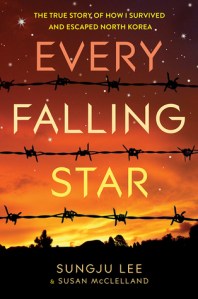
EveryFallingStarThis needs to be a purchase for every library from middle school through high school and that every adult should read as well when it comes out in September. A narrative of how a boy survived and escape North Korea. Written by Sungju Lee and Susan McClelland, Every Falling Star: The True Story of How I Survived and Escaped North Korea is a harrowing account of Sungju’s time in North Korea and the journey to South Korea as a defector. In line with any child soldier narrative from African countries especially Ishmael Beah’s A Long Way Gone, accounts of growing up during the Cultural Revolution in China, Patricia McCormick’s Never Fall Down about Cambodia’s Khmer Rouge, or in recent fictional reads like The Bitter Side of Sweet by Tara Sullivan that describe child exploitation, Lee expresses himself in a genuine and heartfelt manner so that anyone can understand the pain and suffering that exists at the hands of the North Korean government. It’s the ease of his writing that make this a book for any age and no age. The need for these narratives is overwhelming.

Memorable Character: Obviously Lee himself closely followed by his friend and confidante and fellow ‘gang’ member Young-bum. Lee is naive at the beginning, believing that his family who lives comfortably is heading to a vacation spot, when instead their family has been ostracized and sent away. From here, all bets are off and both Lee’s father and mother flee. With Lee having to defend himself and unable to protect the homestead, he forms a gang of kotjebi, whose sole purpose is to watch out for each other and survive through any means necessary. It gets downright ugly. And while hope seems lost, my favorite quote deals with this very thing…

Memorable Quote: “‘To live on the streets means we have nothing left,’ I finally said, then stopped. So many thoughts were moving fast inside my mind, I couldn’t catch just one. ‘Our families-our pasts- feel like they never existed,’ I began again. ‘We’re little more than animals now. At least that’s what the merchants say about us, and the other kotjebi, too. The government once called us the kings and queens of the nation… Everyone has abandoned us. Everything has been taken away from us, except hope. You taught me that we can only give hope away. No one can take it. And you also taught me that hope is what makes us human. That, and love. It’s time to let you go,’ I ended.

Memorable Scene: It will be no secret from the beginnings of the book that the gang of boys that Lee moves with suffer from two deaths, but who of the two is the mystery until they happen. It’s the second that is the most heartbreaking and will bring the most hard-hearted to tears. I will not spoil it, but it is Lee’s reality and a poignant example of the loss of any innocence that remained (though I would question any based on Lee’s story).

Readers are advised to be sure to order multiple copies of this culturally diverse story from a time period not so far in the past but in a place that holds so much mystery. Nothing that Lee write is gratuitous, allowing a range and variety of readers to access his admired story both for having the courage to tell it and to survive it.


“The Greatest”

With the passing of a legend, both in sports and in life, I would be remiss not to remind everyone to revisit his greatness in the Charles R. Smith book illustrated by Bryan Collier called Twelve Rounds to Glory: The Story of Muhammad Ali published in 2007. There’s a reason that it remains on our high school summer reading list with multiple copies sitting on our shelf: it’s the interest, the history, the personality, and the unbelievable understanding of who Ali was in a mere 80 pages.

What I loved about it then and continue to love about it now is how it captures Ali’s essence. It’s like watching director Baz Luhrmann re-create Romeo + Juliet for a contemporary audience, yet you’re still hearing Shakespeare’s lines and get it. Smith uses Ali’s prophetic lyricism and skillful word play to deliver punch after punch to the world and his opponents. Combine this with Collier’s skillful renditions of famous fights and it’s a knockout. Readers learn the chronology of his life and his impact during the Vietnam era. This is a bonus to learning about his athletic prowess, being delivered by Ali’s own words. Those who have seen and heard the clips or are old enough to have watched him during his illustrious career can hear his words spoken as they read them on the page.

If you haven’t picked up this book, you must.


Meeting new people

Over Memorial break, I had the chance to meet two people. James McBride’s mother and Ruth Bader Ginsburg. Yes, just like my fictional friends, I also believe I’ve conversed with real people who’ve been written about or written about themselves. How I would like to sit down for tea with both of them. And with both The Color of Water: A Black Man’s Tribute to His White Mother and Notorious RBG: The Life and Times of Ruth Bader Ginsburg, the writers completely capture the essence of the person… the magic of the person, certainly not an illusion of them.

Though this has been around for close to twenty years, I’ve only just read it and was sucked in in the first chapter. McBride shares the intimate details of his mother’s childhood through parenthood and alongside it narrates the story of his life. Yet, hers truly shines with a uniqueness that is just as apt as her description of God when asked by McBride, that God is the color of water in that he has no color. She is without description and the unraveling of it is skillfully executed.

Another skillful organization is in comparing Notorious BIG to Ruth Bader Ginsburg as Carmon and Knizhnik discuss. How could Tumblr make a pop icon out of the second female Supreme Court justice? It’s easy because Ginsburg is renegade. Using the theme of Notorious BIG’s songs and legacy readers see her power, her words, and her dedication to the law and fighting for equal rights. The variety of information is captivating, from her dissenting opinions (and notes on understanding them) along with images, and a chronology of her rise including plenty of quotes attributed to her. She embodies strength and it shows throughout the book.

In fact, both books focus on their inner strength and motivation to be better and make others better in the process. Both Ruth McBride Jordan and Ruth Bader Ginsburg not only share a name, but they share some magic too.

 
Leave a comment

Posted by on June 2, 2016 in Adult, Nonfiction


Check them out

ReadingOwlAs I mentioned in a previous post, I’m contributing to a blog for the American Library Association’s Young Adult Library Services arm. Here are the past few posts:


Six sensational times two

On Sunday I discussed the emotional tailspin that Perez’s book put me in and vowed to share some of my favorite emotionally-charged stories. But I couldn’t pick just six, instead I found twelve to share with you. If these don’t make you feel something, you may just be grumpy cat.

  1. Out of Darkness by Ashley Hope Perez: See my previous post– ultimately, the racially-charged atmosphere and ill-fated love story climaxes with deadly consequences.
  2. If You Find Me by Emily Murdoch: I don’t cry often over books, but the final chapters of Carey’s reclamation of normalcy after being abandoned by her drug-addicted mother while having to raise her mute younger sister.
  3. Nothing by Janne Teller and Martin Aitken (translator): This book. This. book. The age of the characters mixed with the existential nature of the central conflict of the story make this dangerous but thought-provoking.
  4. Guardian by Julius Lester: The opening of the book is one of the best hooks “But there are times when a tree can no longer withstand the pain inflicted on it, and the wind will take pity on that tree and topple it over in a mighty storm. All the other trees who witnessed the evil look down upon the fallen tree with envy. They pray for the day when a wind will end their suffering. I pray for the day when God will end mine.”
  5. Mudbound by Hillary Jordan: This adult novel digs deep into human emotions, duty, and loyalty with multiple perspectives to move the novel forward focusing on a wife married later in life to a husband wanting to try his hand at farming. The mood is melancholy in this character-driven story.
  6. Such a Pretty Girl by Laura Wiess: Like A Child Called It, students gravitate toward stories that are unavoidably painful. In this case, Cricket has been sexually abused by her father and upon his return, the naive mother continues to side with her husband and not her daughter.
  7. Identical by Ellen Hopkins: The psychological roller coaster of identical twin girls being abused paired with the creativity of the dual narrative again erupt in fireworks by the end of the book, leaving jaws dropped.
  8. Living Dead Girl by Elizabeth Scott: One of the slimmest books out there, it’s staggering that Scott exposes pedophilia in such a raw way.
  9. Lucky by Alice Sebold: Knowing this back story lends itself to a deeper understanding of her fictional The Lovely Bones. The memoir of her rape at eighteen sheds light on how horrible situations can transform a person.
  10. And We Stay by Jenny Hubbard: Think of how Emily Dickinson’s poetry feels and sounds, then think about how a girl seeking answers after the suicide of her boyfriend and discovers her poetry and parallels that will give her comfort.
  11. Touching Snow by M. Sindy Felin: Family dynamics is at the heart of Felin’s book focusing on an immigrant family hiding abuse. At it’s height, Karina is also exploring who she is and who she wants to be, if others will let her.
  12. The Sin-Eater’s Confession by Ilsa Bick: This is one of my favorite GLBT titles that highlights homophobia alongside the beauty of the human form and relationships.
 
1 Comment

Posted by on March 3, 2016 in Adult, Authors, Fiction, Nonfiction, Young Adult


Woodland creatures

As I finish up the invitations for my kids’ birthday party happening at a local nature discovery center, I’m reminded of a few of my favorite outdoor novels. Of course, it wouldn’t be complete without a Gary Paulsen story, but then there’s a movie-adapted nonfiction tale by a master storyteller/investigator, and a newer-ish coming of age juxtaposing a human and an animal that may just be an emerging trend.

What I love about Gary Paulsen’s Winterdance: The Fine Madness of Running the Iditarod wasn’t so much the story of his actually running it, instead, it was the magical way Paulsen describes his bond with the dogs and the runs he did in preparation. I specifically remember a few scenes where his imagery takes over your five senses and you’re touching, smelling, tasting, hearing, and seeing all of the glorious things nature serves up, if only you took time out to do so. It’s that beauty that he captures that’s perfection.

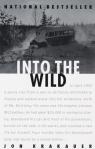
In Into the Wild by Jon Krakauer, the ultimate man versus nature saga trumps the mystery of why Chris would venture to the Alaskan expanse. For me the speculation about all that he must have endured and the lasting image of the young man’s body in the abandoned bus that graces the front cover is fascinating. How could one survive with so little?

And last, Martin Marten, set at the foot of Mount Hood is a spectacular feast that rolls and twists every cool National Geographic WILD show into a side-by-side comparison to the toils of teenage life. Its rich language is as much a treat as the intelligence that shows in how the story is told, yet only a tad maddening as Doyle does not use quotation marks for dialogue: readers must pay close attention to every word in response which plays to its richness.

So here’s to truly wonderful examples of how we all must slow down just a bit and enjoy nature, whether it’s by actually experiencing it or reading about it to make us remember.


Friends?

After reading Francesca Davis DiPiazza Friend Me!: 600 Years of Social Networking in America, I want to highlight my “six sensational” stories of unique friendships in literature.

  1. Bear’s New Friend by Karma Wilson: What’s not to love about the beautiful pictures, vivid colors, and the collection of friends from the ground and the air that hang around with bear?
  2. North of Beautiful by Justina Chen: When Terra meets Jacob in a collective quest to find inner strength from an outward ‘flaw’, they become inextricably linked.
  3. Snow Flower and the Secret Fan by Lisa See: All of See’s works are gorgeous, but the historical significance and flowing language of this secret language is beguiling.
  4. Chemical Garden trilogy (Wither, Fever, Sever) by Lauren DeStefano: From the eye-catching covers to the unique storyline of three girls of varying ages brought together to be wives for a man who, like them, is losing the battle with a genetic predisposition to die prematurely, the three ‘sister wives’ bond in varying ways.
  5. The Boy in the Striped Pajamas by John Boyne: On opposite sides of the fence, the Jewish boy on one side of the fence is befriended by the Commander’s son on the other with a heart-wrenching end.
  6. Selection series (The Selection, The Elite, The One, The Heir, The Crown) by Kiera Cass: Similar to DeStefano’s books, a crew of girls come together, this time in a palace to vie for the affections of a prince, with one girl seemingly disinterested repeatedly winning the attention from the prince.
 

A firsthand account

I had previously written about Temple Grandin’s story in a previous post about how extraordinary her perspective is on her autism diagnosis and how she lived with it then and how it’s changed now. You can absolutely add John Elder Robison’s perspective to the list of nonfiction reads about people growing up in a ‘different’ world.

The brother of Augusten Burroughs, RoLookMeIntheEyebison also lends his view on his parents’ crumbling marriage, alcoholism, and mental illness that Burroughs details in his books. But the value of the story is in his comparison to how his Asperger’s was  dealt with and looked upon when he was a child and how he lives as an adult, able to appreciate his savant tendencies to focus on something deeply. In the past it was electronics and digging holes and as he aged it was cars, specifically engines, and guitars–leading to work with famous bands and a lifelong hobby of detailing high-end cars.
The book isn’t without hi-jinx and trouble with many anecdotes that would have landed him in a facility or lockup today that are humorous, dangerous, and everything in between. I was entranced by his storytelling and self-awareness and less focused when he discussed the humdrum of his everyday existence or specifics of his time in the music and toy work worlds.

The potential of the story lies in his connection with other people who are different to showcase everyone’s amazing talents regardless of labels and abilities, which is a necessary voice to those that feel different and don’t know how to capitalize on it.

 
Leave a comment

Posted by on January 12, 2016 in Authors, Nonfiction


Sneakers

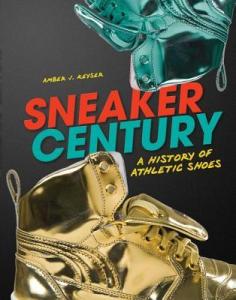
It’s no secret that over the last four years, I have become obsessed with reading nonfiction, especially when it’s relevant and accessible to high school students: Keyser’s Sneaker Century: A History of Athletic Shoes is just such a book.

I will full-on confess that I own one pair of sneakers at a time and my most recent purchase were more expensive because they were custom fit for my type of workout as well as my tendency to walk on the inside of my feet. They aren’t a name-brand but they’re amazing. I also confess that in high school, I was obsessed with Adidas for no particular reason than I loved the threeSneakerCentury-stripe.

Keyser’s book reveals so much about the brands we know and love including their backstories, the history of footwear and how sneakers impacted popular culture, how jogging became a recreational activity, and name-dropping athletes and their association with specific companies. All of this is neatly compacted into less than one-hundred pages. As I said, accessible in every way. And relevant. A recent author visit with Jason Reynolds had us talking about sneakers: specifically he referenced showing up to college with a bag full of sneakers and having a conversation with his roommate about why he didn’t have more than a pair or two. How many do you own? Do they each have a story to tell?

 
Leave a comment

Posted by on December 16, 2015 in Authors, Nonfiction, Young Adult


Graphically speaking

DonBrown

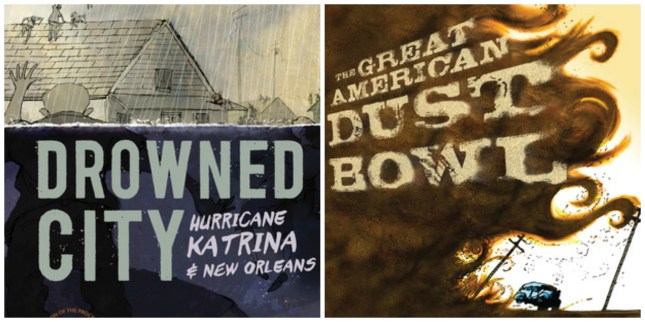
Simply looking at the two covers of Don Brown’s graphic nonfiction books allow a glimpse into the talent Brown has in illustration. But the story and storytelling are equally evocative. In fact, a reader learns as much through the text as they shown by turning the pages of these accessible stories providing perspective on two disasters that affected Americans.

The Great American Dust Bowl showcases the man-made tragedy of dust storms sweeping the west during the early 1900s after the land was taken from Native Americans and turned over to farmers who, without proper knowledge, farmed the land to excess. This led to dust storms that brought financial ruin, health issues and death, and environmental devastation. And with little dialogue and a precise narrative, the shocking story is ripe for discussion about what actions were taken (or not) which prolonged the problem.

Likewise, Brown makes the issue of action– or lack of it– central to Drowned City about Hurricane Katrina: trains that left stations without passengers, buses that were never called upon on top of politicians that would have known more if they turned on the television rather than from their own administrations, and the lack of basic necessities at the Superdome and local hospitals.

Brown makes you think and react because his visual art is stunning and rich. There are images etched in my brain and facts that I can quickly recall that make his work thoughtful and enriching.