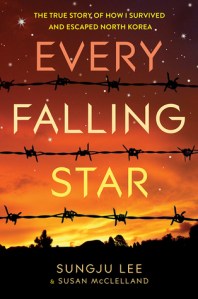
 This needs to be a purchase for every library from middle school through high school and that every adult should read as well when it comes out in September. A narrative of how a boy survived and escape North Korea. Written by Sungju Lee and Susan McClelland, Every Falling Star: The True Story of How I Survived and Escaped North Korea is a harrowing account of Sungju’s time in North Korea and the journey to South Korea as a defector. In line with any child soldier narrative from African countries especially Ishmael Beah’s A Long Way Gone, accounts of growing up during the Cultural Revolution in China, Patricia McCormick’s Never Fall Down about Cambodia’s Khmer Rouge, or in recent fictional reads like The Bitter Side of Sweet by Tara Sullivan that describe child exploitation, Lee expresses himself in a genuine and heartfelt manner so that anyone can understand the pain and suffering that exists at the hands of the North Korean government. It’s the ease of his writing that make this a book for any age and no age. The need for these narratives is overwhelming.
Memorable Character: Obviously Lee himself closely followed by his friend and confidante and fellow ‘gang’ member Young-bum. Lee is naive at the beginning, believing that his family who lives comfortably is heading to a vacation spot, when instead their family has been ostracized and sent away. From here, all bets are off and both Lee’s father and mother flee. With Lee having to defend himself and unable to protect the homestead, he forms a gang of kotjebi, whose sole purpose is to watch out for each other and survive through any means necessary. It gets downright ugly. And while hope seems lost, my favorite quote deals with this very thing…
Memorable Quote: “‘To live on the streets means we have nothing left,’ I finally said, then stopped. So many thoughts were moving fast inside my mind, I couldn’t catch just one. ‘Our families-our pasts- feel like they never existed,’ I began again. ‘We’re little more than animals now. At least that’s what the merchants say about us, and the other kotjebi, too. The government once called us the kings and queens of the nation… Everyone has abandoned us. Everything has been taken away from us, except hope. You taught me that we can only give hope away. No one can take it. And you also taught me that hope is what makes us human. That, and love. It’s time to let you go,’ I ended.
Memorable Scene: It will be no secret from the beginnings of the book that the gang of boys that Lee moves with suffer from two deaths, but who of the two is the mystery until they happen. It’s the second that is the most heartbreaking and will bring the most hard-hearted to tears. I will not spoil it, but it is Lee’s reality and a poignant example of the loss of any innocence that remained (though I would question any based on Lee’s story).
Readers are advised to be sure to order multiple copies of this culturally diverse story from a time period not so far in the past but in a place that holds so much mystery. Nothing that Lee write is gratuitous, allowing a range and variety of readers to access his admired story both for having the courage to tell it and to survive it.


 As I mentioned in a previous post, I’m contributing to a blog for the American Library Association’s Young Adult Library Services arm. Here are the past few posts:



 bison also lends his view on his parents’ crumbling marriage, alcoholism, and mental illness that Burroughs details in his books. But the value of the story is in his comparison to how his Asperger’s was dealt with and looked upon when he was a child and how he lives as an adult, able to appreciate his savant tendencies to focus on something deeply. In the past it was electronics and digging holes and as he aged it was cars, specifically engines, and guitars–leading to work with famous bands and a lifelong hobby of detailing high-end cars.
 -stripe.