RSS

Getting involved is NOT overrated

gettinginvolvedisnot

On my way back from the American Library Association’s Midwinter Conference in Seattle yesterday, I was thinking about what my theme would be for the post-conference post. I wasn’t quite sure which is why it’s about 24 hours later. But on my way home from work today, I realized it had to be about getting involved. Honestly, it was kind of my theme for the conference itself.

Why was it my theme? Here’s what I did differently this time around.

  1. I volunteered at the YALSA booth for the first time. I told myself this year I would do it. Former committee members of mine had done it before and I thought I couldn’t do it because I didn’t know enough, but they set good examples of being involved. So I got involved. And it was delightful to chat up the organization and meet others volunteering as well.
  2. I made sure to connect with colleagues who I knew were attending from across the country because I realized at Annual last year, that if you didn’t make it a point, it wouldn’t happen serendipitously. So I reached out ahead of the conference and got involved in asking my colleagues what they were up to and when we could meet.
  3. I was on an award committee. Yeah, I know! It was a goal and I made it and it felt awesome and I’ll definitely do it again. In the meantime, I’m on selection committees to fill my need to read and share good books with the world.
  4. I book-talked at a publisher breakfast (and at 7:30am used taboo words but it was for the cause) to share my love for an upcoming book. Who better to hear from than colleagues (and kids when we can) about good books to read? Nevermind that yogurt squirt forth from the cup onto my dress a mere half hour before. My tip? Eat after you do your booktalk. So I got involved in sharing my love of books that publishers want us to love.
  5. I talked and smiled more. There were several people I met at activities then saw over and over again the rest of the conference. How nice to get out of our libraries and meet others and hear their opinions and perspectives and ask questions. So I got involved simply by being more open (but I still liked curling up in the hotel bed with cheesy TV at night).

If you haven’t been to a national conference, get to one soon. While none of this is groundbreaking, it does remind us all to use our talents and strengths and then share, share, share them with others.

 
Leave a comment

Posted by on January 30, 2019 in Events, Young Adult


Peek behind the curtain: the teenage brain

peekbehindthecurtain

The last several years, I’ve been increasingly interested in expanding my knowledge about the teens I work with. My own children are elementary-aged, so it’s preparation for their own teenage years, but in the meantime, it’s is exactly right for my job working as a high school librarian.

Beside running a professional development course with the book Brain Literacy for Educators and Psychologists by Virginia W. Berninger and being able to apply the science to several books I have read recently (Proust and the Squid: The Story of Science and the Reading Brain by Maryanne Wolf– which has an update on my TBR list called Reader, Come Home: The Reading Brain in a Digital World.) Then, there’s the book that I’m recommending to parents of teens, parents who WILL have teens soon, and those that work with teens in any capacity. As with many of the nonfiction titles I read because I’m curious about the topic, the Post-it count was high. I should really buy stock in the company.

inventingourselvesTitle: Inventing Ourselves: The Secret Life of the Teenage Brain
Author: Sarah-Jayne Blakemore

Copyright: 2016, then re-printed in 2018 by PublicAffairs

Relevance: As I said above, if you have teenagers (or will soon) and/or work with teenagers, books like these remind us of our own teenage selves, provide scientific research and snapshots of studies with conclusions we can use to better inform our interactions with teens. And it’s not all negative. We need to continue to learn about the brain as science speeds forth and isn’t what you knew during teacher training programs or even that book from twenty years ago when you just started out.

Ah-ha! Post-it note: Synaptic pruning occurs voraciously during adolescence and embodies the motto “if you don’t use it, you lose it”, which is being investigated as a cause of the education slump that occurs around middle schools years (at different points for everyone in their development process) in which grades and performance dip for a short period of time.

Memorable quote or fact: The brain takes of 1/5 of the energy used by the body.

 
Leave a comment

Posted by on January 18, 2019 in Adult, Nonfiction


8 systems for reading more

8systemsforreadingmore

As human beings, we know that if it is important, we’ll make it a priority and find the time in our schedule to do it. For readers that “it” is reading. And like any good resolution to start a good habit whether for its own sake or to replace a bad habit, systems are put in place to make it happen.

As is the case for reading more, the systems might be

  • Making sure that wherever you go you have a book with you. This could mean a book in your bag, a downloaded ebook or audiobook on your phone, keeping one in the car, or at your desk at work.
  • Actively changing the pattern of reaching for your phone and instead reaching for your book if you spent your down time scrolling.
  • Purchasing materials to make a book nook at home to make it a comfortable reading spot. This might mean a comfy slippers, a plush blanket, a new armchair.
  • Changing behavior and reading for 15 minutes when you wake up in the morning rather than turning on the TV or likewise turning off the TV and reading for 15 minutes before bed to gain momentum.
  • Picking materials that you WANT to read. No one should be forcing you to read things you don’t want to so when you’re picking something because you enjoy it whether it’s a steamy romance or self-help book or future science, you’ll find yourself reading more when you’re enjoying the content itself more. Reading classics only works if you WANT to read classics. And the same goes if you aren’t enjoying the book you’re reading– there’s plenty of inspiring quotes that life is too short to be reading a bad book.
  • If you’re increasing your reading, you might want to make sure your public library card is up to date.
    • I’m a book borrower, rarely a book purchaser (except for the purchases I make working in the library) and that’s an economical choice because I read so much.
  • Join a book club or have a book buddy. Someone that enjoys the act and can push, pull, prod, and inspire you to continue on your reading journey. For some, this is the motivation they’d need to build their momentum. Or at the very least, start a relationship with your local public librarian or indie bookseller because they’re just as passionate about books and would happily engage in conversations around what they’re reading and what you’re reading.
  • Practicing the art of reading focus. We can binge watch on Netflix, but it’s hard to binge read? Never! But for those that haven’t done it in a while, you need to get your stamina back and that means the concentrated focus we have at work to accomplish a task can be applied to good ol’ fashioned reading. Plain and simple.

idratherbereadingOne of the systems I put in place years ago was that my lunch at work in a busy school library was to read. First (and this is aimed at every educator) was to take my lunch and the second was to use part or all of that time to read. It was astounding how many more books I read over the week, month, year when I began this practice. And for 2019, I vowed to capture more of my lunchtime reading by bookstagramming them and using the hashtag #literarylunchbox. Feel free to follow my journey on Instagram @readersbeadvised.
What systems will you put in place to make reading a bigger chunk of your life?

 
Leave a comment

Posted by on January 4, 2019 in Blogging, Miscellaneous


Top 10 of 2018: Adult edition

Copy of Top10of2018

Clearly I read a bit more young adult and middle grade titles than adult titles because my job is working with teens, but as I get older I enjoy taking the time out to read some adult titles. You’ll probably notice a bit of a theme, like the stuff in my Netflix queue, so if you didn’t get to read any of these titles when they were published this past year, put them on your list for 2019.

Top 10 of 2018- Adult Edition

  1. A False Report: A True Story of Rape in America by T. Christian Miller and Ken Armstrong: Detailing a 2008 rape report by Marie after a man broke into her apartment, the writers share the circuitous way in which a man was finally brought to justice after a long hard traumatic road.
  2. An American Marriage by Tayari Jones: From it’s superb cover to the dynamic storytelling of Celestial and Roy’s relationship after he’s imprisoned is a slow burn that is full of frustration, love, resentment, and loyalty.
  3. Bingo Love written by Tee Franklin and illustrated by Jenn St. Onge: A queer love story with rich illustrations and a painful yet sentimental relationship about two women, Hazel and Mari who after meeting years ago were apart yet find their way back together decades in the making.
  4. How to be A Good Creature: A Memoir in Thirteen Animals by Sy Montgomery: Featuring thirteen animals who had an impact on her life and are reflected in the dozens of books she’s published for teens and adults over the years, it allows all of us to pause and reflect on how animals affect our lives from their presence to their absence.
  5. I’ll Be Gone in the Dark: One Woman’s Obsessive Search for the Golden State Killer by Michelle McNamara: True crime fans will likely have already bought this the day it came out and it was made more superb by the fact that the Golden State Killer was literally identified not too long ago after McNamara’s quest to identify him over years of her life. We’ve all been sucked into a project that won’t loosen it’s grip and this is evidence of one woman’s true obsession.
  6. Impossible Owls: Essays by Brian Phillips: I picked this one up after seeing it on a best list for 2018 since I’ve also been reading more essay collections. Phillips is a dynamic storyteller and makes the most mundane fascinating but also allows readers to peek behind the curtain of activities like the Iditarod and seeing tigers in the jungles of India.
  7. Not that Bad: Dispatches from Rape Culture by Roxane Gay: Gay’s strong voice is a lightning rod of thoughtful observations that go without saying.
  8. Period: Twelve Voices Tell the Bloody Truth edited by Kate Farrell: The compilation of stories about menstruation is a worthy read for everyone because they are honest, emotional, beautiful, and empowering. Let’s change the dialogue.
  9. Saga Volume 9 by Brian K. Vaughan and Fiona Staples: Now they’re taking a break after that ending? Gut-wrenching! But this space opera is the most creative and original work featuring star-crossed lovers and their journey filled with imaginative characters including Alana, Marko, and their daughter, Hazel.
  10. Spying on Whales: The Past, Present, and Future of Earth’s Most Awesome Creatures by Nick Pyenson: He’s probably biased because he’s a Smithsonian researcher on whales and I’m probably biased because I love whales and marine life in general. From digging up bones and to understanding their immensity, it’s also a message to humans inhabiting this planet that we must take care of all creatures and not hunt them to extinction.

I love animals, can’t you tell? I like true crime but you figured that out too. And a well-drawn and imaginatively well-written graphic novel, check. Let’s celebrate the diversity and creativity of the books that were published in 2018 and tip our hats to the authors continuing to hone their craft and new writers that will bring that much more for 2019.


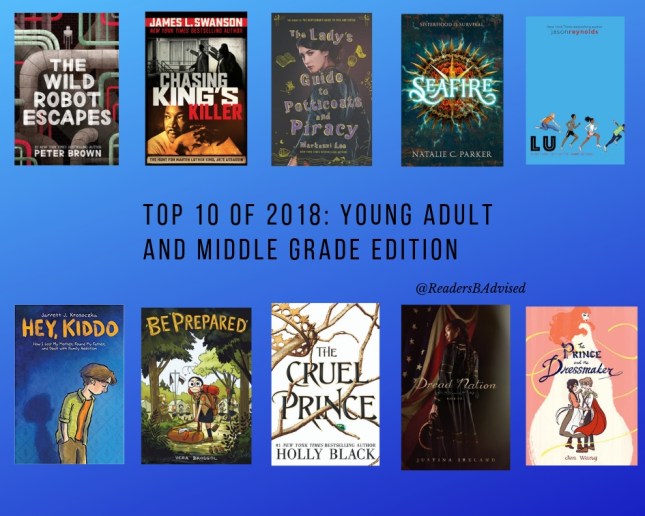
Top 10 of 2018: Young adult and middle grade edition

Top10of2018

I’ve been thinking making a list and checking it twice for my picks for the best YA and MG titles published in 2018 (in addition to my shout out below of the finalists for the 2018 William C. Morris Award Committee of which I was a part).  In alphabetical order- the books that I shouted from the rooftops about:

  1. Be Prepared by Vera Brosgol: This fun romp is a reminder that we were all awkward growing up and nervous about making friends. Special appearance by the local convenience store, Stewart’s, makes this an especially lovely local story!
  2. Chasing King’s Killer by James Swanson: I continue to be blown away by the quality of Swanson’s research and his aptitude to bring history to a younger audience. He truly makes history sexy.
  3. The Cruel Prince by Holly Black: Ironically this published at the beginning of 2018 and I’ve already read the ARC of The Wicked King and give that five stars too. Black knows how to create an intense atmosphere in a faerie land.
  4. Dread Nation by Justina Ireland: Sign me up for more alternative history. This mixes zombies, the Civil War, and race relations and allows a kickass heroine to shine with her sassy attitude.
  5. Hey, Kiddo by Jarrett Krosoczka: A graphic novel memoir that began from Krosoczka’s TED talk about his childhood and allows our authors to be human and teaching empathy.
  6. The Lady’s Guide to Petticoats and Piracy by Mackenzi Lee: I stayed up past my bedtime to finish Lee’s book in one sitting. This companion focuses on Monty’s sister Felicity with a penchant for medicine and no outlet to practice in a man’s world.
  7. Lu by Jason Reynolds: There is nothing sadder than the end of a beloved series. Reynold’s Track series was an instant hit and each story with their vivid covers and realistic characters shone like the North Star guiding young readers about right and wrong, healthy relationships, and the meaning of community.
  8. The Prince and the Dressmaker by Jen Wang: The coloring of this graphic novel compliments the emotions and story of a prince who loves to wear dresses and his relationship with his dressmaker keeping the secret… until it’s not one anymore.
  9. Seafire by Natalie Parker: Every female empowerment anthem plays when I see the cover and remember my feelings reading this book that mixes the best of Lumberjanes with seafaring and the ultimate fight against evil. These ladies have my heart.
  10. The Wild Robot Escapes by Peter Brown: I immediately finished this sequel and ordered both for my elementary-aged sons. This sentimental story about Roz, a robot now living on a family farm who longs for the freedom she once had on an island caring for a gosling. Heartfelt science fiction adventure at its best.

Top 10 of 2018_ Young Adult and Middle Grade Edition

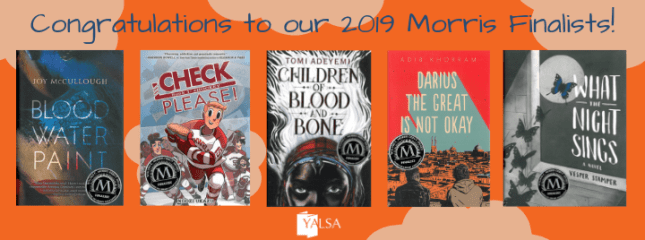
In addition, January 2019 finishes my term as a member of the William C. Morris Award Committee through YALSA, which means I read a lot of debut novels besides my usual cache of books. With all of that reading, our committee came up with the five finalists announced last week and we will vote on the winner next month that will be announced at the Youth Media Awards in Seattle, Washington. Here were the finalists:

  • Blood Water Paint by Joy McCullough
  • Check, Please! #Hockey by Ngozi Ukazu
  • Children of Blood and Bone by Tomi Adeyemi
  • Darius the Great is Not Okay by Adib Khorram
  • What The Night Sings by Vesper Stamper

2019 Morris Award Finalists Feature Slide

Cheers to the reading you did in 2018 and all of the books to be read in 2019 and beyond!


A night at the library: 5 things

ANightAtTheLibrary5Things

Last night, my colleague and I hosted 92 high school students for our third annual library lock-in that we’ve re-branded Falcon Library After Dark. Our activities included pizza, three movie screens, computers, tabletop games, video games, double Dutch, corn hole, Legos, and an all-night activity if they chose to undertake it– a BINGO-like challenge that got them talking, investigating, and thinking. This was followed by a short dance party before running our nonfiction gauntlet and collecting their Blow Pop.

Students get to hang out and be themselves with their friends and make new friends. They enjoy the camaraderie and excitement and an opportunity to relax for an evening before heading into the weekend at home. And it got me thinking- what would I do if I were in the library all night? Here are five things:

  1. Sit down and just be. Our library is nothing if not active. If we have to close for a period or after school, which doesn’t happen often, it’s nearly impossible for anyone– students and staff alike– to believe it as they rattle the doors and stare in. Therefore, sitting down and just being in the library is a luxury. While most library’s aren’t shush zones, there is something beautiful about a silent library… sometimes.
  2. Make myself a cup of tea. I joke that I’d be opening up Pandora’s box if I started drinking tea at work because I drink enough outside of work, but on the rare days where I need to warm up, there is a stash in the office.
  3. Wander the shelves. I take pride in our collection. I turned into a nonfiction reader about a decade ago and haven’t looked back. I often read nonfiction during my lunch. I’m also just as obsessed with graphic novels and fiction, so no matter where you are in the library, there’s something fantastic to read at your fingertips. It would be lovely just to feel with my fingertips and scan with my eyes.
  4. Ignore my desk. Wouldn’t it be tempting if I were locked in the library all night to sit down and work? Of course, but this is not that kind of fantasy.
  5. Read. What did you think number five would be? After wandering the shelves, it would be nearly impossible not to have pulled some off the shelves and snuggle in for the rest of the night to read– in the comfy chairs, at the table, in between the stacks.

What would you do if you were in a library all night?

 
Leave a comment

Posted by on December 1, 2018 in Events, Miscellaneous


Sandwiches! Stick a fork in it

SandwichesPutaForkInIt

This post was first published on the Times Union Books Blog

When I say sandwich, which one do you think of first?

2018-05-05 08.02.35On May 20, 2018, my family and I embarked on a journey of epic proportions inspired by the Alison Deering book illustrated by Bob Lentz called Sandwiches!: More Than You’ve Ever Wanted to Know About Making and Eating America’s Favorite Food. The book landed in our high school library and over my own lunch I began reading, giggling, and nerding-out over the hundreds of factoids about famous sandwiches and the hypnotizing illustrations that accompanied them.

Soon after drooling over the entire book, I started to talk about the useful (and humorously useless) information shared but also in how neatly the information was presented. On the left, a graphic of the complete sandwich with a brief introduction surrounded by dates, biographies, and scientific notes related to the sandwich. And on the right, a manual for putting together the sandwich with additional information if you wanted to make certain items from scratch or if you wanted to level it up with additional items.

I brought it home to share with my elementary-aged sons who also began pouring over the spreads and thus was born the quest to make EVERY sandwich in the book- all 52 of them. It’s November 26, 2018 and last night we noshed on the last one which couldn’t have been eaten any time before as it’s The Gobbler- the quintessential post-Thanksgiving sandwich where all of the dishes end up in one pile between two slices of bread. We actually also kicked it off in style too as I was hosting a longtime friend who appreciates a good meal so we started the journey with the hummus sandwich, chips, and a beer for the adults.

On my personal blog, I have shared three posts, Sandwiches! Part I, Sandwiches! Part II, and Sandwiches! Part III about the food adventures along the way. Let it be known that this is the final installment: Sandwiches! Part IV where I highlight the final few not because we did them in order per se and they were at the end or that they were the “hardest” to make, but simply that’s how we crossed them off our list of breakfast, lunch, dinner, and dessert sandwiches. The last few included the Banh Mi, the Po’ Boy, and the Italian Beef among others but not before trying out one that is the author’s own non-traditional favorite without a real name.

Few books have had an impact like this one has on trial and error, experimentation, and conversation. I have friends and family who have kept tabs as I’ve posted pictures on Instagram using the hashtag #makingallthesandwiches or made one for them. But the most fun was in what my kids thought and what ended up being their favorite even as we tried things like the spaghetti sandwich and the mac and cheese sandwich. Again, not that these are new sandwiches (as my husband lamented plenty of times), they just remind you of regional items, cultural elements, and history. He’s had a long history with sandwiches, but who hasn’t? Our small, old kitchen was put to the test along with our stomachs, but it’s been one heck of a seven-month journey.

What are your favorite classics or do you have one that’s all your own that you want to share? Maybe if Alison Deering hears about it, she’ll put it in her next book.

Gobbler

#drippinggravy


The Adobe Spark adventure

AdobeSparkAdventure

Technology is a double-edged sword in that it is not the fix for everything, but it is useful for many of our activities in school. Namely the presentation. I try to think back to how I was when I was in high school and presenting in my classes, but I can’t remember. I know now, I enjoy presenting to others. I’m specifically indulgent when it comes to my presentation slides as I’ve shared before. But in the past? I haven’t the foggiest.

A 9th grade English teacher wanted to add some technology into some of her units this year especially because she isn’t completely comfortable either. We chatted and settled on a group project where they present their poem to the class and discuss some of the elements of the poem and central idea. I shared Adobe Spark with her and said it would be a great visual addition to use the Spark web page design to lay out the poem and build in a reflective piece asking them why their group chose specific photos and videos to highlight the text by using the breadth of beautiful stock images (or their own if they chose to import). I created an example based on my favorite poet, Pablo Neruda, and she was sold.

Body of a Woman

Then it worked out spectacularly that I would be observed teaching this lesson and the stars aligned. Students took to the site and dove right into work. All four sections of her class were like this and I was astounded by their willingness. The ease was because of their ability to use their GSuite login to create the account (and some were guided to use Canva also using their GSuite login) to add extra pizzazz. The only drawbacks were that as a group project, they could not share and/or edit together. While all had input on it’s creation, it was only under one student’s account. But what it did have was the ability to share to Google Classroom (in addition to a few social media options, embed code, or a link) making it easy for classroom teachers.

Their feedback reflected its ease. Many students liked using something different, but just as many unfortunately said they would have liked to use the ol’ standby Google Slides, which as a librarian is a bit disappointing because of the domination of Google products in education and students’ forthrightness but unwillingness to think about the adventure of something new. Through observation though, I know that they enjoyed the adventure in the moment, but when all was said and done, they would rather use a trusty tool. I get it, people like what is comfortable.

The results were phenomenal as were their reflections about the process as a whole, and the teacher was satisfied. I’d call this successful too. In part because as a librarian I’m always sharpening my skills by taking courses like Polly Farrington’s Cool Tools for School (which is where I learned about Spark a few years back). And I had an impact on a teacher whose professional goal was to incorporate more meaningful technology in the classroom.

A win on all fronts.

 
1 Comment

Posted by on November 17, 2018 in Poetry


Tags:

What’s left of me after reading We Are All That’s Left

WhatsLeftofMe

How do I begin this post? Do I start by profiling and detailing my love for Carrie Arcos’ We Are All That’s Left and go from there? Or do I start by sharing a bit about the students that I work with every day and then talk about her book? Or third, start with a chapter of my husband’s story and then talk about her book? Better yet, let’s talk about all three.

Years ago I ran a “Warring Worlds” book club at our high school library that was in direct response to having read a senior’s common app essay about escaping the war in Bosnia when she was a child and I was stopped in my tracks thinking that my husband, an Army veteran who spent time in Bosnia with the 10th Mountain Division could have been close by. It dawned on me how interconnected we all are. And even though some of our students had been born in the United States, we were sill embroiled in a war in Iraq and Afghanistan at the time, so everyone experienced war, just in different ways.

Every day I get to listen to our refugee students whose experiences are so different from my own. They know what it is like to be in fear for their life, they know what hatred looks like, they know how important education is when it’s often denied to them in their native land before coming to the United States.

2018-11-09 18.41.04So when I began reading Arcos’ book and the first flashback chapter told from Zara’s mom, Nadja’s point of view in 1992 in Visegrad I knew there was something special. It took a little bit to build as there was an uncertainty between the dysfunction of Zara and Nadja’s mother-daughter relationship, but it ballooned once readers began to connect Nadja’s war-torn young adulthood and Zara’s discovery of Nadja’s hardships as Nadja lays comatose after a bomb detonates at the farmers market they were visiting. Zara is wounded and suffering from post-traumatic stress while again, her mother is hospitalized unable to communicate. It becomes less about the present day and more about Nadja’s survival against the atrocities of war while trying to hold on while the trauma of murder and rape burns through their family, neighborhood, and country.

Arcos eloquently details these dark times that keep from being morose because we know that Nadja survived and has a family, though her daughter is now just coming to realize what her mother experienced. It’s a powerful emotional tool to foil Zara’s life and Nadja’s and set against the backdrop of the Bosnian War delights me in that this event is rarely detailed in young adult literature. While it was neither here nor there that Arcos was not born or raised in Bosnia, her extensive research demonstrates command of the events and a powerful need to share it with others by connecting the generations. It’s masterful. And reminiscent of other titles like Erika L. Sanchez’s I Am Not Your Perfect Mexican Daughter and any of Ruta Sepetys’ historical fiction that shed light on imperfect times in our past. And heartbreaking the way Ashley Hope Perez’s Out of Darkness was. It belongs on the shelf with these pillars of historical fiction because of it’s profile of the darkness (and light) of humanity when all light seems to have been lost.

So I advise young adults and adults to savor this gem of historical fiction that brings the present and past together with heart and tenacity among the darkness.

 
Leave a comment

Posted by on November 9, 2018 in Authors, Fiction, Young Adult


Can it be “see ya later” not goodbye?

CanItBeSeeYaLater

I had been lucky to attend conferences around launch time for Jason Reynolds’ previous Track books so I never had to wait like the rest of the world to read them when they were published. So when I was in a bookstore this weekend (who knew?!) I couldn’t pass up purchasing Lu, the fourth and final book in his middle grade Track series. And of course because it was chilly and rainy today, I thought what better time than right now to devour it? 

Then I regretted it. Why? Because it’s the last one.

2018-10-28 19.22.48What was I thinking? Plenty of us avid readers have felt sadness in the last book of a beloved series and this one was no different. Reynolds is the GOAT, period. Whoever designed the covers needs a raise. Reynolds’ ability to create deep characters with authentic middle grade voices has been spotlighted in this series and shines again with Lu, another track star under Coach’s tutelage who is helping his father right his wrongs while hopefully looking toward a future with a baby sister when his mother should have never even been able to have him. Rich with inspiration and motivation, it’s the power of our human experience through Lu whose Albinism hasn’t changed his perspective much, in fact his newest job as big brother has allowed him to grow as he passes through the awkwardness of youth.

This book is all that’s right with middle grade literature and the superstar that is Jason Reynolds. I’ve already placed an order for an additional four for our high school library because I will push the complete series like candy on Halloween (away from me and out into the world to be enjoyed by others) so it won’t be goodbye, rather “see ya later”.

 
Leave a comment

Posted by on October 28, 2018 in Authors, Cover Love, Fiction, Middle grade