RSS

Category Archives: Miscellaneous

Quests

As part of the #edublogclub year-long challenge to blog on education, this week’s topic focuses on project-based learning.

I needed to tell this story similar to the last prompt but representative of this week’s prompt as part of the #edublogsclub weekly inspiration. This isn’t about student problem or project-based instruction rather than problem-based work that I recently completed with the help of colleagues and happens a few times a year. But this one affected me more.

Our library stores copies of old yearbooks. And because our school dates back to 1868, needless to say there’s some history. Our yearbook collection begins in 1918 and while many don’t come looking for ones that old, they are still looked through. Yet recently, we’ve been getting requests for pictures of alumni from the 1960’s. Can you guess why? Many of our students went off to war. Some never graduated. Some graduated, left for war, and never returned. And projects taken over by citizens to be sure they are properly memorialized means having to track down their high school yearbooks for a picture. Some do not have pictures next to their names on memorial walls because there wasn’t one and they want to be sure they are properly memorialized.

That means that when we’re contacted, the wheels begin turning. We had two high schools, so look through the yearbooks for an indication, if not contact our registrar to see if there is a file in our basement of past graduates and attendees. If they didn’t attend here or briefly, is there any information about where they left to or came from. Is it at our city hall if they went to a school which is now defunct? And so begins the circle, because to simply reply: “they did not graduate from here” or “they did graduate from here but aren’t in the yearbook, sorry” do not cut it. Not for this lady. I want to empower them with as many leads or as much information as possible. And that truly is problem-based and feels more like a quest than anything else.

We want our students not give ask yes or no questions and we want them to not give yes or no answers back, but to explore. And each time we field a call or email, we are leading by example.

And what was the resolution to this request? Our veteran who died in the second-worst helicopter accident in Vietnam. We have yearbook photos from another school district in his freshman and sophomore classes, but no transcript indicating that he actually graduated from our school, though we do know he attended for a brief time. It is fascinating to read about his story, see a picture of a fifteen year old boy, and know the sacrifices that he made. 

 
2 Comments

Posted by on April 29, 2017 in Miscellaneous


Assessments for reading: “Miss, this ain’t English class”

As part of the #edublogclub year-long challenge to blog on education, this week’s topic focuses on assessment.

In this week’s suggested post topic around assessments, I’m going to connect with what I know best: reading and libraries. Specifically, finding an engaging way to assess reading rather than a book report, log, or journals. So I want to share what a science colleague and I have been doing for the last several years.

She became hooked on the Alane Ferguson forensic mystery series and came in to pick my brain about a way to incorporate reading into her forensics classes. I quickly shared dozens of ideas and pathways to get there asking questions about what product she wanted and what the objective was. What it became was a mix of reading, writing, speaking, and listening skills over the course of three to four weeks, twice a year. And our favorite line was spoken to her after our first attempt way back when when the student asked why they were reading in science class saying “Miss, this ain’t English class.” The process?

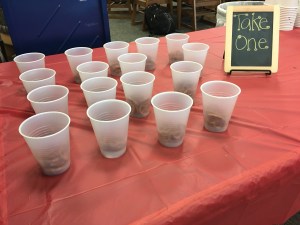
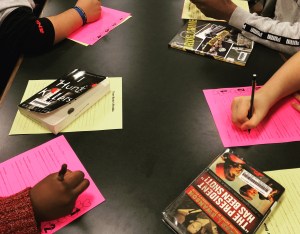
  • Come to the library for a book tasting where they get to interact with a diverse 2017-03-07 08.48.57group of fiction, nonfiction that included the graphic novel format and had a forensic theme. They would spend five minutes at each table and circulate until they found a book they wanted to check out.
  • They had two reading logs to complete throughout their reading time.
  • During this reading time (outside of class), science teacher would meet for brief intervals during a work day and ask them about how they were enjoying their book and sharing something interesting about hers to gauge their engagement. This was informal and not graded and provided an avenue to connect individually.
  • Students filled out a book profile card (similar to a dating profile) for their book to get down the basics and refresh their memory in preparation for the final activity with was book speed-dating. This preparation day included a brief video that modeled speed dating.
  • The following day, students would spend the forty minute period sitting for six minutes at a time one-on-one with a classmate sharing and questioning each other about their books. They’d be scoring their likelihood to want to read the book their classmate described and on the classmate’s “presentation” of the book. As the timer rang, they’d rotate again.

So, there are alternatives to a book report. Students must own their reading and be able to intelligently share out about their book to classmates. Their grade was based on their individual presentations to the classmates in a timed speed-date. An alternative to a book report? Absolutely! I’ll take these over a test about a book to show comprehension any day.

 
2 Comments

Posted by on April 12, 2017 in Authors, edublogsclub, Miscellaneous


The art of the booktalk

This post originally appeared on the Books Blog for the Times Union

The art of the booktalk. When a friend asks you about the book you’re reading or you’re sharing a recent fabulous read, how do you approach it? Do you ask a question? Perhaps have a pre-planned teaser or maybe you’d rather share an overview. Sometimes I’m so blinded by the emotion of absolutely loving a book that I clutch the book to my chest and whisper I love this book and then just hope that someone will take my word for it. Luckily I’ve got some street cred with this approach.

2017-03-30 15.40.02-1But, I was thinking about the art of the booktalk after spending two days in classrooms talking to tenth graders about choosing a classic book to read for their fourth quarter project. I had a lot of ground to cover and not all of the books I had read. Yet that is nothing new because I booktalk frequently on topics that I may only know slightly and I am a firm believer that you can booktalk a book you haven’t read. I organized the books into categories that helped channel the number that I was talking about and then prepared my cheat sheet (things like publication date, title characters, main ideas, themes or topics, or a relevant current topic that paired nicely). And while this is necessary, I generally don’t use it as much as occasionally reference it since Benjamin Franklin put it best when he said
“By failing to prepare, you are preparing to fail.”

It’s there if I need it, but the preparation solidifies my approach and then I don’t actually need it. Especially when I capitalize on others in the room who may have loved one of the books and ask them to share. When I talk about a book I may ask a hypothetical question or have a one-liner that intrigues someone, saying little more. And I learn from others. I facilitate a book group of local school librarians and everyone has a slightly different approach, all valuable in their own way. There are some I could listen to all day myself, admiring their vocabulary and word choice. I aspire to be better after each delivery and rework it until I hit booktalk gold. We only get better with practice.

So not only am I constantly honing my booktalking skills based on my audience, I also realized I have a lot of classic literature to read (or reread to refresh my memory). Maybe I can make this a monthly post to review a classic book as a way to kickstart this exploration. Which would you start with?


The swinging pendulum

As part of the #edublogclub year-long challenge to blog on education, this week’s topic focuses on the swinging pendulum– trends in education.

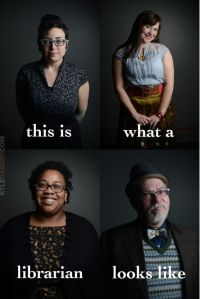
Things have settled down for a bit now, though every few years librarians, especially those in schools have a panic attack about what we’re called. Rest assured, I will never argue because I will never want to be called anything other than a librarian. The only qualifier I’d add is “school” librarian (versus public librarian or academic librarian) but even then, I’ve put too much effort into it.

LibrarianLooksLike

From the Cardies and Tweed WordPress blog

The panic can be attributed to two events: the infusion of technology in schools and the recession. The former called in to question what the role of the librarian was (or wasn’t) and the latter slashed jobs in reaction to tightening budgets at the expense of students (along with programs like music and art). So we wanted to keep relevant and with that came the need to reinvent ourselves a la Madonna or Sean Combs. Madonna did it with her music and fashion choices while Combs did it with name changes. Librarians followed Combs’ strategy. What if we called ourselves school media specialists? But we’re also instructors, so what about teacher librarians? Many couldn’t fathom staying librarians without a name change to go along with our changing role.

But I’ve never had this crisis. I’ve been a librarian for ten years and I will continue to be a librarian well into the future. Is it because I know what I’m about and therefore don’t need to fuss about a name? Probably and also it’s confusing to change names. Maybe that’s why many more women are also choosing to not change their names when marrying– there’s an ownership over who you were for years before meeting a significant other. I own being a librarian. I love being a librarian. I even had this conversation at a Board of Regents presentation several years ago.

And, it simplifies things when I go to work at the library every day. I’m a librarian and I work in a library? Mind blown! Plus, it translates well in their non-student lives because they have access to other libraries now and in their future and aren’t we about the same things? We’re sharing print and digital resources, providing community spaces, engaging in conversations and advocacy, and bringing people together.

That’s my mission, my passion, my job, my title. Period.


4 Comments

Posted by on March 29, 2017 in edublogsclub, Miscellaneous


Embed THIS!

As part of the #edublogclub year-long challenge to blog on education, this week’s topic focuses on embedding something.

Embedding is always exciting and sometimes aggravating but imagine my excitement when I realized that the Padlet I created to share resources on a presentation I was giving actually has a specific embed code for WordPress– as in, copy and paste this address rather than lines of code inside the body of the blog post and it will automatically embed. Cool, huh? When we talk about how integrated and networked devices, apps, and websites are, these are the shining examples.

Today I had the privilege of presenting at the New York State Council for the Social Studies. The first presentation centered on current books representing timely topics like child exploitation, trafficking, and social movements. And the second (back to back and in separate rooms leaving little room for error in disconnecting and reconnecting my laptop, cables, and bags) was about new literacy. For the attendees, I wanted to share websites, articles, videos, and images and decided Padlet was my mode of delivery. So if you’re interested in the topic, check out the collection of resources

Enjoy the resources and be happy that you were not me during the presentation (though I will say I think I handled it flawlessly) where many of the resources and videos I wanted to show live never happened since the Internet wasn’t working. But damn, my slides looked amazing! (see previous post about the importance of images for me)


1 Comment

Posted by on March 23, 2017 in edublogsclub, Events, Miscellaneous


Feedback face-to-face

As part of the #edublogclub year-long challenge to blog on education, this week’s topic focuses on feedback.

One of my favorite assignments when working with an upperclassmen group conducting research was when I came in to discuss the initial thoughts, tips, and tricks on “revving the engine for research”. For many teachers I worked with, I helped shape a document that set deadlines for parts of the research and subsequent paper that provided a realistic scaffold of conducting research but also helped demonstrate time management.

Specifically though, they had to submit several essential questions and a working thesis statement along with two complete citations of articles they had found so far. Then I graded this and went back into the classroom and talked with the students where they were given the next step: this was a formative grade, not summative. If students wanted to earn back points, they’d set up a meeting with me in the library and resubmit the assignment.

This served two purposes: first, students learned that revising and editing is as important as the process and the paper itself. Do not be afraid to revise. The second was that, we wanted them to grow as learners, which meant that reflecting on how well (or not well) something was working can be continually improved. So, providing an individual conference is a necessary step to provide reflection and also resources to help them move on, when sometimes students wouldn’t ask until it was too late, if at all.

As a school librarian, individual attention is just as important as group instruction, especially with upperclassmen. If in our large school of 2,500 students, their underclassmen teachers didn’t take advantage of the resources my colleague and I could provide, then students might not know the library was a resource. So as a sixteen, seventeen, or eighteen year old, individualized attention was almost a necessity to recoup some of that lost time from previous years.

And the levity they showed after a twenty-minute conference was a positive step in empowering them to ask questions, reach out, and reflect, so that they will return. So I leave you with a humorous meme from madamedefargeknits.tumblr.com:

LiveDangerously


I’m booked

There’s work that includes the regular stuff and the presentations both for students and upcoming ones for colleagues and other professionals. Then there’s home stuff that includes my kids’ birthday and a very large home renovation project. So while there are days when I must stare longingly at the books sitting on my end table or diligently tote around my Nook waiting fora  spare few minute that never comes to read, I am busy when I can be reading. Mainly graphic novels and mainly because I’m excited to be part of the American Library Association’s Young Adult Library Services Association’s Great Graphic Novels for Teens committee.

While we’ve done nothing more than exchange emails, they’re already a pretty awesome group and I’m already diving deep into graphic novels of every shape and size. So, I want as many recommendations as possible. What are you loving, what are you liking? What new ones are you anticipating for 2017?

I’ll listen, maybe not to the lady at the grocery store talking about her cat, but I will listen to anyone who has suggestions about their favorite new releases. Otherwise, I’m booked!

readersbeadvised


“Are those gray hairs?”

As part of the #edublogclub year-long challenge to blog on education, this week’s topic focuses on popular culture in the classroom.

Pocketwatch

Recently on a visit to see my parents, my mother asked me about those shimmering strands on my brunette head. Yes, I have a few silvery hairs that I believe that in the right light they look blonde. Still, true to my thirty-something years where I have never dyed or colored my hair, I will go gray gracefully and not such a single piece.

But, it was a few years back (before the grays) when I finally realized I wasn’t as connected with popular culture as I once was just by being a young teacher. Yet I’m also confessing that I’ve never been “one” with popular culture. I grew up listening to country music, technically lived in the country rather than the suburbia that made up my school district, didn’t like the clubs, and I usually could never tell you the names of celebrities or sports figures when asked. Plus, my own kids are still in elementary school. I use things like the urban dictionary and what’s trending and popular on YouTube to help a bit, but I want to focus instead on contemporary culture versus history, specifically 9/11.

At this point, any kid in high school (remind you I work in a high school library) would have been no more than a few years old, if not yet conceived, when the September 11th attacks occurred. So any book published about it and even Hurricane Katrina (2005) is considered historical fiction. This discovery a few years back was a game-changer for me. My experiences are no longer their experiences too: Generation Z are digital natives, while my group, the millennials, had technology but not as much social connectivity using it.

Clothing and hairstyle fads along with slang and music will always move fluidly, so I can never truly count on these as measurements of popular culture, but I think the idea of experiences connected to historical events is. Because former president Barack Obama was in office for two terms so most high school students haven’t known another president until now- they haven’t had to. Because our phones are digital, more students have a hard time using an analog clock (I won’t begin to explain how weird is was to explain how to use a rotary telephone to my friends when they visited when I was in elementary school). So the best thing to do moving forward it continue to adjust myself and thinking based on what I have experienced and what they have experienced to be able to connect rather than what they’re wearing and who they’re listening to

 
Leave a comment

Posted by on March 8, 2017 in edublogsclub, Miscellaneous


Student privacy: respect it

As part of the #edublogclub year-long challenge to blog on education, this week’s topic focuses on student privacy.

As a unique educator in that the 2,500 students that attend the public high school that I work at are all “mine” since I work in the library means that any given program, activity, class project, or visitation could mean meeting a student I have never met before or that has never come to the library before. It also means that at the beginning of the school year I haven’t sent home a photo release form from our school to post or not post images of my one class or multiple classes that I have direct contact with if I was a classroom teacher. With that in mind, as I do for my own elementary-aged children, I do not want my own kids’ images plastered on social media for the sake of capturing an exciting educational moment unless it protects their privacy or I have given permission. That’s where creative camera work comes into play.

Many of my favorite memorable moments from programming in the library have been avoiding students’ faces and focusing on the atmosphere or activity. Now, I’m not saying I’m Dorothea Lange, but I know my way around my iPhone camera to capture the moment without student faces. Yes, I have them, but they’re not the ones that get shared. This is important. It’s also why I teach Googling your name and do so often with my and my family’s name to see what is out there. This is an element of digital citizenship that people must get out in front of, even if it’s simply to know what’s out there. We must be aware of what it out there attached to our identity or others that have similar or the same name. It can take the form of a picture or simply your name or your affiliated institution.

Ultimately though, it is as much our responsibility as educators as students and their parents to be sure that they can control what and where they can. So, here are some examples from our own social media postings where we avoid showing student faces. For us, it’s about angles, light, or putting teachers in the foreground.

This slideshow requires JavaScript.

 
2 Comments

Posted by on February 22, 2017 in edublogsclub, Events, Miscellaneous


Six sensational new releases

As part of the #edublogclub year-long challenge to blog on education, this week’s topic focuses on creating an listicle.

I spend most of my free time reading. Both because it’s my favorite hobby and it’s also my job. It’s been a while since I’ve posted a six sensational list, so let’s get back into it since my #edublogsclub challenge this week is to create a listicle (if you don’t know what that is, look it up!) Here are six sensational new releases in order of their publication date.

  1. What Girls Are Made Of by Elana K. Arnold
    • Not for the faint of heart, Arnold packs a punch. Nina’s relationship with her mother, who does not believe in unconditional love shapes Nina’s relationship with Seth. It’s dark and vividly portrayed and oh, so necessary.
  2. Ronit & Jamil by Pamela Laskin
    • This is Romeo and Juliet where Ronit is an Israeli girl and Jamil is a Palestinian boy and what happens when they fall in love… in verse. Breathtaking!
  3. Crazy Messy Beautiful by Carrie Arcos
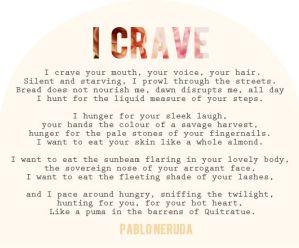
    • If you’re named after the poet Pablo Neruda, you must use his poetry to woo the ladies. And Neruda is a hopeless romantic and an artist, but it’s the friendship he forms with Callie, a girl in class that allows him to work through his own feelings about friendships and relationships, especially when one closest to him is fractured and he’s caught in the middle.
  4. The Impossible Fortress by Jason Rekulak
    • Remember those early video games? Know how popular virtual reality is now? Well mix the two and you’re back in 1987 with Bill and Mary, the main characters of the story where Bill’s friends want to see Vanna White naked and Mary is a girl coder working on her family’s computer in their store. It’s about their relationship to coding, to each other, and darker secrets that will be uncovered.
  5. The Careful Undressing of Love by Corey Ann Haydu
    • I’m a fan of offbeat stories and this one is an homage to one of my favorite adult novels, Jeffrey Eugenides’s The Virgin Suicides. In this story, the girls of Devonairre Street cannot fall in love because the men always die. They’re a curiosity that is now attracting tourists to this quaint street. It’s the story of their pain and what kind of future they can have with this awful power.
  6. Florence Nightingale: The Courageous Life of the Legendary Nurse by Catherine Reef
    • A powerful look at a woman who is known as a legendary nurse yet wielded significant power as a manager with adeptness at numbers and charts. Her style made some cry and her work essentially drove her sister mad since she felt that Nightingale overshadowed her.

As always, these are just a few of the many I’ve read and a snapshot of some of the newer titles that will be released soon (or were released in the recent past) worth reading if you are a fan of young adult literature.

sixsensational