After finishing up a long holiday weekend where the biggest spectacle is beautifully-colored fireworks with the right amount of boom and pace to inspire awe that’s the thought I had when I finished The Stonekeeper, the Amulet series’ first book by Kazu Kibuishi. No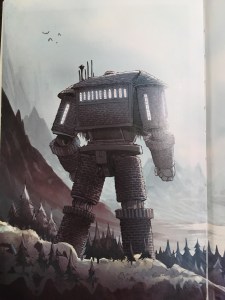 t only will I continue to ride this adventure wave of a series, I look forward to the stunning visuals that Kibuishi provides. It’s a true visual treat and I’m not one to slow down to engage with the pages as much as I probably should, yet I did with this one.
Memorable character: I’m going to throw out to you that my favorite character isn’t actually the kids or fun robotic characters or Miskit, it’s actually Emily and Navin’s mom. The woman loses her husband, then with moans and groans from her kids, realizes that the best place to bring her kids is an old family home both to save money and I’m sure to find something to hold on to. I loved her can-do attitude in getting out the pails and Pine-sol to spruce up the creaky place and her willingness, always, to protect her kids, even when she’s gobbled up by a blob. No wonder her kids are so eager to save her because I certainly know a few kids who’d look the other way and continue on their adventure.
Memorable Scene: When the house moves! How gorgeous a visual even with little to no color in the scene, but this is exactly the type of creativity and adventure that makes this series worth investing in. Even the previous scenes when Miskit, disguised as a boatman, ferries the kids across the water are luscious and rich. Mmmmm!
I can’t wait to put the rest of the series on my TBR pile and be sure to order enough copies to handout like it’s my job. Oh wait, it is my job!
 aracter is tween/teen and dealing with life. The realistic, down-to-earth kind of story that makes it an “every person” book, not for a specific subset of readers. In addition, like the other graphic novels’ illustrations, I am on board with the vivid coloring and rounded illustrations that are in stark contrast to darkly explored stories in black and white.