RSS

Category Archives: Authors

Against the grain

Sometimes a book and you just don’t click, even when they’re the most talked about and you really, really want to like it, but you just can’t. That’s the way I feel about two recent reads and I think I can put my finger on what I didn’t like about them, though that’s not to say that they won’t speak to others. Yet, for me, I had to stop the CPR… an apt quote for those times when it’s just not working out.

The first was Simon vs. the Homo Sapiens Agenda by Becky Albertalli which won the Morris Debut Author award for 2016 and the second was A World Without You by Beth Revis which will be out in just a few short days and is already buzzed about.

Starting with Simon, I could tell from the first chapters that I wasn’t going to be into it primarily, as a testament to the newer YA fiction that’s out there like The Great American Whatever by Tim Federle or Look Past by Eric Devine, because authors are pulling away from a book centering around the character’s sexual identity and instead incorporating it into a larger story. And then once I got to know Simon, I became more disinterested by the banter between his secret friend that seemed contrived while none of the secondary characters shined for me to champion either. Flatline.

As for Revis’ new book, I wanted it to be Challenger Deep by Neal Shusterman and when you love a book as much as I love Challenger Deep, it’s hard to compare. I tried to stay objective and keep an open mind but the problem was that I didn’t read the summary before reading the book, so I didn’t already realize that it had been explained that Bo does have a mental illness though he believes he’s at a home for exceptional youth. I started the book thinking I was reading magical realism akin to Miss Peregrine’s Home for Peculiar Children by Ransom Riggs, when in fact, they are delusions in which he believes he has transported a girl at the school to another time period and lost her there. Again, this is not the case: she has committed suicide and Bo cannot accept this fact. But, there is no explicit description. And even when the secondary narrator, Bo’s sister Phoebe is introduced, you would think this would provide clarity. Instead, it’s superfluous and muddies the water further. Flatline again though the struggle between what is real and what is imaginary is a very real peak into mental illness and what Shusterman illustrated so well for me.

I will continue on, as my TBR pile so eloquently demonstrates, but these were not favorites.

 
Leave a comment

Posted by on July 12, 2016 in Authors, Fiction, Young Adult


That lasting feeling

AfterwardI don’t yet have Jennifer Mathieu’s name committed to my memory, so imagine my surprise when I finished my newest download from Netgalley called Afterward and posted my review on Goodreads only to realize I’ve read two others from her! So now, I must commit her name to memory as she’s turned out some lovely and touching stories. In finishing Afterward, I can say that the lasting feeling I have is akin to Oribiting Jupiter by Gary Schmidt. It’s this quiet recognition of a well-written story that sticks in your bones.
As Mathieu mentions in her afterword, this story doesn’t happen in real life very often, but it does happen and it’s worth writing about, especially when memorable characters are created and the the story unfolds as an homage to the courage it takes to survive but also to the self-care needed to move past difficult situations as Ethan and Caroline’s story attests to.

Memorable Character: Ethan without a doubt, as a boy who was taken as a pre-teen by a man who abused him and controlled him for years, is now back in the arms of his parents who tried to never give up hope that they’d find him again. He takes to meeting with a psychiatrist who provides him an avenue to explore what happened to him that includes bringing his his dog and also allowing Ethan to ask the tough questions: is he gay because he had to do that with Marty? Should he tell Dylan’s sister, Caroline, that he feels responsible for Dylan being kidnapped as well because he opened the door and “played the part”? How can he move on and go back to school? How much smothering should he take from his mother? There’s is a slow character development that endears readers to him from the very moment we learn who he is, that he has suffered abuse from a man who committed suicide when the cops finally found Ethan and Dylan. He’s open to a friendship with Dylan’s sister, who is trying to come to terms with Dylan’s kidnapping as well and befriends Ethan under the shared hobby of music. He wants everyone to feel comfortable, even when he was ripped away from his family for years before finally being rescued.

Memorable Scene: Each scene in the garage when Caroline rides up on her bike and starts a conversation with Ethan and subsequently meets him to “jam out”. It’s such an innocent way to begin their friendship. Caroline is curious about Ethan’s experiences and how she can use him to help her autistic brother deal with it as well. The alternating narratives help understand both Ethan and Caroline’s motivations creating a unique story.

Advised to give this to fans of Gary Schmidt’s Orbiting Jupiter and Jasmine Warga’s My Heart and Other Black Holes.


Leave a comment

Posted by on July 7, 2016 in Authors, Fiction, Young Adult


A sight to see

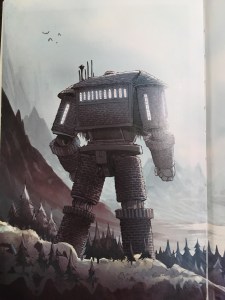
After finishing up a long holiday weekend where the biggest spectacle is beautifully-colored fireworks with the right amount of boom and pace to inspire awe that’s the thought I had when I finished The Stonekeeper, the Amulet series’ first book by Kazu Kibuishi. No2016-06-29 19.36.46t only will I continue to ride this adventure wave of a series, I look forward to the stunning visuals that Kibuishi provides. It’s a true visual treat and I’m not one to slow down to engage with the pages as much as I probably should, yet I did with this one.

Memorable character: I’m going to throw out to you that my favorite character isn’t actually the kids or fun robotic characters or Miskit, it’s actually Emily and Navin’s mom. The woman loses her husband, then with moans and groans from her kids, realizes that the best place to bring her kids is an old family home both to save money and I’m sure to find something to hold on to. I loved her can-do attitude in getting out the pails and Pine-sol to spruce up the creaky place and her willingness, always, to protect her kids, even when she’s gobbled up by a blob. No wonder her kids are so eager to save her because I certainly know a few kids who’d look the other way and continue on their adventure.

Memorable Scene: When the house moves! How gorgeous a visual even with little to no color in the scene, but this is exactly the type of creativity and adventure that makes this series worth investing in. Even the previous scenes when Miskit, disguised as a boatman, ferries the kids across the water are luscious and rich. Mmmmm!

I can’t wait to put the rest of the series on my TBR pile and be sure to order enough copies to handout like it’s my job. Oh wait, it is my job!


Straight ’til morning

…that’s how I read this book: in one sitting, way past my bedtime, so be sure that your schedule is clear until morning when you crack open Never Ever by Sara Saedi. It was the combination of an easily-readable narrative, an imaginative setting, with a darkness that compliments both the romantic elements and relationships among the characters.

Memorable Character: Wylie, the main character who has discovered her father’s affair and is trying to keep some peace while her parents decide to divorce and her younger brother is a day away from jail because of an accident that she helped cause. She’s befriended (and a bit smitten) with Phinn, a boy at a party who gives her a flower that allows her to fly before he takes her and her two younger brothers to Minor Island, the island where none of the inhabitants ever grow up. It’s what happens on the island and how Wylie responds at each turn that create the darkness as she discovers her “Peter Pan” may have a darker side that turns this Peter Pan story into Lord of the Flies.

Memorable Scene: Close the beginning, it’s when Phinn decides to pull out the small pouch that looks like it has been woven out of reeds and presents her with a bundle of tiny blue flowers that he’s asking her to try “hoping we could have an adventure together”. Realistically unnerved and curious, Wylie immediately begins to walk away before Phinn eats one and demonstrates that their consumption allows the consumer to fly. (And the fairy tale begins…)

Memorable Quote: A scrawl on a wall and a poem recited on the island “Never forget to live life to the fullest. Do it for the troubled; do it for the lost. The days may feel shorter; the nights may feel long. But when we remember, our memories grow strong.” This was the Phinn-created mantra that ends up being the biggest (and darkest) twist to the plot.

This is absolutely one of the more enjoyable 2016 reads with the splashes of magical realism that’s got a choke-hold on me right now, but it’s the attention to family since Wylie is joined on the island by her two brothers Micah and Joshua and the interwoven details of her parents, and the lasting questions readers can pose to themselves– if you could stay on an island and never age, would you leave everything else behind?


Leave a comment

Posted by on June 30, 2016 in Authors, Fiction, Young Adult


What’s old is new

I am a fan of re-tellings, but with everyone that I do read, there are twenty more that I’m not aware of. It’s a question of the chicken or the sense that I ask myself, if I know that this is a re-telling, should I go back and read (or re-read) the original story so that I’m more prepared to understand the subtleties of the re-telling or let it be? Of course many I don’t realize until after, like Exit, Pursued by a Bear is based on Shakespeare’s A Winter’s Tale. I’ve got my The Complete Works of William Shakespeare queued up after having discovered the inspiration.

And this newest post, about Samantha Mabry’s A Fierce and Subtle Poison. It wasn’t until I was booktalking the book to an English teacher as we trade our recent reads that she said, hey, that sounds an awful lot like Hawthorne’s short story, I think it’s something daughter. Curious. So I looked it up and downloaded a PDF and tore through the twenty-page short story written by Nathaniel Hawthorne in the 1800s. Why yes, this was absolutely a re-telling and Mabry’s title is taken from the short story to boot. There’s a girl who is full of poison, there is a boy who likes her. She breaths on an insect and that insect dies. And of course there are a few differences like the setting (Italy versus Puerto Rico) and adults versus teenagers, but I would have never known had I not talked about the book with someone more widely read than I. And I feel bummed about that, that sometimes I’m unaware of the allusions, but I try to convince myself that you can’t possibly read everything to know where the inspiration came from. That makes me feel (slightly) better. I think about the statistics that tell readers that it’s just not physically possible to read every book that’s published and again feel (slightly) better.

So, do you read Hawthorne’s Rappaccini’s Daughter first and then Mabry’s A Fierce and Subtle Poison? Do you read only what you’re comfortable with (a short story from the 1800s or a YA novel from the 2010s)? Do you read what fell into your lap first and then read the other? Well, I guess that’s up to you. I know I feel better having discovered and read Hawthorne’s text to see where Mabry’s inspiration came from, the question is, with teen readers of Mabry’s book want to read the dense short story?

I enjoyed Hawthorne’s story for its more gothic appeal– the beautiful and mysterious daughter of a mad scientist who many men pine after but not many men have seen. The star-crossed love as Giovanni discovers his love for Beatrice and realizes he himself has become poisonous as she already is. Should you cure it or let it be? And to what extent will the overbearing father infiltrate himself? Ultimately both Beatrice and Giovanni must live with the tragic consequences. This is in contrast to the somewhat lighter novel. While there are still gothic elements including descriptions of the girls as they wash ashore as well as the mythological stories that the women on the island tell about the villa at the end of the street, it’s juxtaposed with the narcissism of Lucas, the son of the hotel billionaire on the island. Lucas doesn’t learn the language, he just uses the local girls and discards them until he meets Marisol. Then Marisol goes missing and messages are slipped under his door from the mysterious girl from behind the walls of the villa– Isabel. Will the resolution of this novel align with the short story? You should read them both to find out!

 
1 Comment

Posted by on June 26, 2016 in Adult, Authors, Fiction, Short Story, Young Adult


Hollow out time for Wolf Hollow

WolfHollowThere’s something about reading a beautifully-crafted and lyrical children’s book that instantly reminds you of the classics like Charlotte’s Web, Tuck EverlastingPeter Pan, and James and the Giant Peach.  Lauren Wolk’s Wolf Hollow will become a contemporary classic if I have any say.

Annabelle has tried to befriend Betty, a new girl living with her grandparents in their Pennsylvania town, but it’s difficult. Betty wants Annabelle to bring her things or she’ll beat her. And Betty does in addition to terrorizing a friend of Annabelle’s and a younger brother. But the absolute worst occurs when Betty begins blaming an innocent military veteran who lives on the outskirts of town. And mild hysteria comparative to a witch hunt ensues. Yet Annabelle knows the truth and is able to spend time with Toby, the veteran and neighbor, hearing stories about his life so moving that Annabelle’s confession to readers is that “I held very still and waited, trying not to hear it all, hoping, even at just eleven, almost twelve, that I would never have sons of my own.”

Tragedy is at the very root of the book in powerful scenes that transcend readership and touch on society’s reactions to marginalized individuals, but also what the power of kindness can do to overcome these baseless conclusions.

It should be on everyone’s reading list from children that is the intended audience to adults since they can connect instantly with Annabelle’s upbringing and Toby’s post traumatic stress. Yet one of the best elements is its resolution: messy, aggressive, powerful, and for most readers unsatisfactory in that while there is some hope, a lot was lost in the process. This ending is my kind of ending.


Six sensational cultural stories

This slideshow requires JavaScript.

After finishing Tara Sullivan’s The Bitter Side of Sweet two days ago, I was moved by sibling relationship between Amadou and Seydou, but also blown away by the atrocity that is child labor on cacao farms in African countries. It was pointedly apparent when the boys taste chocolate for the first time and are shocked that what they farm is a treat for children across the world, while they are beaten and starved and forced to work to farm the bean. So with a return to my six sensational lists– here are my favorite multicultural stories that span interest level.

  1. The Bitter Side of Sweet by Tara Sullivan: A tragic circumstance brings Khadija to the farm where Seydou and Amadou are forced into labor and her willful disobedience and a farming accident press the three to escape their captivity in a fast-paced action story with a powerful message.
  2. Touching Snow by M. Sindy Felin: Karina’s Haitian family is fearful of authority and being deported even after Karina’s stepfather visciously attacks her within inches of her life. As she heals, she is also coming of age and questioning both her sexuality and her purpose.
  3. Garden of Stones by Sophie Littlefield: With three generations of women involved in the story, it’s ultimately about the Japanese internment camps and the relationships, abuses, and survival techniques employed to be able to continue living.
  4. Esperanza Rising by Pam Munoz Ryan: Need I say more about why this book is on the list? A gorgeously lyrical story of Mexican immigrant farming lands in the United States with Esperanza’s beautiful descriptions of the earth’s heartbeat and her mother.
  5. Morning Girl by Michael Dorris: Having read this over ten years ago this character-driven story of Morning Girl and her brother Star Boy as they co-exist in their beautiful country through Christopher Columbus has other plans. The political undercurrent is useful in providing a perspective while the morality creates a complexity that is fitting for older readers.
  6. Keeping Corner by Kashmira Sheth: Leela has led a privileged life until the death of her husband who she’s never met. At her young age, she’s expected to traditionally mourn all while a revolution is taking place led by Gandhi both against British colonists as well as India’s caste system. It’s depth is moving and educational.
 

Diverse debut

Meredith Russo was recently interviewed by School Library Journal on diversity with her debut book If I Was Your Girl, which came at an awesome time as I’d just finished the book last week. Within the week, also making sure I returned it to the public library after booktalking it to a group of other librarians at a book club and adding multiple copies to our next order for the school library.

IfIWasYourGirlThe premise is that Amanda is going to live with her father after a beating in a mall bathroom in the town where she currently lives with her mother. Thinking that Amanda can start fresh in a new place, the obstacles of truly being accepted by her father and then being a girl in a new school are enough to wreck her nerves. But, things are settling in well and Grant, a kind-hearted boy, has already taken an interest in her. And while she wants to tell Grant about her being born a boy, his insistence that he’s not interested in any “secret” puts Amanda at ease. For the first time, allowing herself to truly enjoy being herself, though she has told another girl she befriended at school.

It’s a strategically told story with a crisp voice that is neither too flowery nor too pointed. There is a comfort in Russo’s storytelling that allows for a bit of complacency before another traumatic event unfolds, sending chaos into Amanda’s life yet again. It’s the characters, from Amanda and Grant to her father that explore the emotions of a trans experience. I think it’s a cut above others in its categorization, serving a more rounded understanding of transitioning still feeling guarded, a necessary measure to protect oneself. It explores religion and homophobia, secret-keeping, and family.

It’s got a provocative title and cover that compliment each other, which is where I always start with a book. Then add to it an author’s note about Russo’s own experience and it’s a book needing to be on everyone’s shelf to read and then share widely.

 
1 Comment

Posted by on June 5, 2016 in Authors, Fiction, Young Adult


“The Greatest”

With the passing of a legend, both in sports and in life, I would be remiss not to remind everyone to revisit his greatness in the Charles R. Smith book illustrated by Bryan Collier called Twelve Rounds to Glory: The Story of Muhammad Ali published in 2007. There’s a reason that it remains on our high school summer reading list with multiple copies sitting on our shelf: it’s the interest, the history, the personality, and the unbelievable understanding of who Ali was in a mere 80 pages.

What I loved about it then and continue to love about it now is how it captures Ali’s essence. It’s like watching director Baz Luhrmann re-create Romeo + Juliet for a contemporary audience, yet you’re still hearing Shakespeare’s lines and get it. Smith uses Ali’s prophetic lyricism and skillful word play to deliver punch after punch to the world and his opponents. Combine this with Collier’s skillful renditions of famous fights and it’s a knockout. Readers learn the chronology of his life and his impact during the Vietnam era. This is a bonus to learning about his athletic prowess, being delivered by Ali’s own words. Those who have seen and heard the clips or are old enough to have watched him during his illustrious career can hear his words spoken as they read them on the page.

If you haven’t picked up this book, you must.


Pop Shakespeare

After having just read and posted about Exit, Pursued by a Bear and now just finishing after an obsessive day of reading Dreamers Often Lie by Jacqueline West, I am elated by the resurgence of Shakespeare-inspired YA fiction.

For this story, there is no doubt that Shakespeare seeps from the pages from the title to the incorporation of a main character who acts: you’d be hard-pressed to find an actor who hasn’t played a character in one of his plays. Jaye is now in high school and playing Titania in A Midsummer Night’s Dream opposite her childhood friend, Pierce, who has been distant over the last few years, but is taking up acting in his senior year. Yet Jaye’s life has been rocked by a brain injury during a skiing accident with her mother and sister. Not only does she want to leave the hospital to get back to the play and her friends, she’s feigning good-health when instead she’s seeing and hearing Shakespeare characters including the bard himself, Hamlet, and Romeo. Romeo turns out to be the new kid in town and a love interest for Jaye, while also epitomizing the possible bad decisions that Jaye has continuously made and that had disappointed her father before his untimely death. Insert the love triangle as Pierce becomes overprotective of the healing Jaye.

There is much to discover within the pages, from lines from the plays to Jaye’s family dynamics, healing from a brain injury, and healthy decision-making. The writing and pacing engage readers from start to finish with a seamless incorporation of the hallucinated characters. So once readers tune in to Jaye’s new normal, the book is easy to follow. It’s not about mental illness and it’s not true magic, it’s simply her brain’s reaction to the trauma. And she certainly doesn’t want to admit it to anyone either.

With the amount of drama between the pages, it doesn’t have to be a “literary” teen who will enjoy it because it’s contemporary realism with a pinch of canon. But you better be ready to hear from them once they turn the final pages. It wouldn’t be true Shakespeare without it.

 
Leave a comment

Posted by on May 31, 2016 in Authors, Fiction, Young Adult