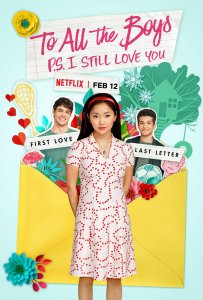
Romance is not a category of fiction that I seek out regularly. But give me a good romance on the small screen like Netflix has done with Jenny Han’s book series and I’m sold.
I watched the first one and was exceptionally impressed with the visual beauty of the movie, not to mention the story, casting, and music (of which I have no great knowledge or understanding of). My critiques of movies are simply my enjoyment factor, so I’m sharing, as a reader of young adult literature this advice: watch the movies.
The second one launched near Valentine’s Day just a few days ago and I was excited to clear my queue during my morning workouts for it. And again, it did not disappoint. Similarly stunning visuals took my breath away and the music enhanced every scene that it played. Plus, I’ve already squeezed in a second watch because it was just so damn adorable. And there were jellyfish (even if it was a heartbreaking scene).
So here they are, the reasons that you should be watching:
The color scheme is stunning.
The pop culture influences are not overwhelming but reminiscent of the great 80’s-style teen movies of that decade from the texting to the house parties to how it represented school life.
I made an Instagram story yesterday evening. It was a picture from the back of the Photography II classroom of a dozen kids looking at Isabel Quintero and Zeke Pena, the author and illustrator of the graphic novel Photographic: The Life of Graciela Iturbide that I blogged about in 2019 alluding to this collaboration. Above it I said “I f*ing love what I do” with a bouncing heart emoji over the Smartboard projector in the photo and a gif of a girl waving a book next to the words “school librarian”.
Because, I f*ing love my job as a school librarian and days like this remind me of that exponentially.
I’ve spent about a month in and out of this class working with the teacher and students to include the graphic novel into their identity unit that teaches them about portrait taking where they photograph six different portraits for the project.
Remember and remind yourself of days like these above on the days that I feel like this below:
Some readers have rituals. For a lot of my reading librarian friends specifically there was a lot of late 2019 chatter about their last book of 2019 and/or their first book of 2020. I fall into the same category whereby I strategically plan specific books around occasions. I fall into the latter category of planning both my last book and my first book, both of which ended up being five stars.
Last book of 2019
Marie Lu’s Rebel, the fourth book in the Legend world that takes place in the future in which Daniel’s brother, Eden, is attending university in Antarctica where they’ve settled while June is still working in the Republic. The story, like Lu’s others, have two narrators that are differentiated by the text color as they pace the book out with the developing conflict as it switches fluidly back and forth. The world she creates is superb and the futuristic action is heart-pounding.
First book of 2020
Monica Hesse’s yet-to-be-released They Went Left that’s anticipated for an April release. Not only have I read Hesse’s other YA historical fiction titles, but her adult nonfiction book American Fire. All showcase her skillful writing. This one fits in a newer focus of YA books on the liberation of Jews after World War II like the Morris finalist from last year, What The Night Sings by Vesper Stemper. Hesse dives into this world with Zofia, who has lost most of her family but still holds out hope that her younger brother Abek has survived. Shifting to several places before settling into a relocation camp where she meets a brooding boy, Josef, she is reunited with Abek but questions about what both boys have been through since the war broke out provide the riveting content of the book’s second half. Put this at the top of your list for April.
You can follow all of my reading and review on Goodreads and plenty of bookstagramming @ReadersBeAdvised on Instagram.
Last year I shared two lists: an adult and a YA/middle grade top 10 based on the books published in that calendar year. This year, absent from my list will be any fiction titles since I’m finishing up my term on YALSA’s Best Fiction for Young Adults blogging team. Our final list will be available soon and in the meantime you can see the titles we’ve all blogged about throughout the year.
Now onto my top 15 published today, December 15th for 2019.
Graphic novels (in no particular order)
Laura Dean Keeps Breaking Up With Me by Mariko Tamaki and Rosemary Valero-O’Connell: The color palette and storyline is richly detailed with the internal romantic lives of teenagers, especially highlighting unrequited and abusive relationships in a powerful story.
Pilu of the Woods by Mai K. Nguyen: A family-focused middle grade graphic novel with a vividly earthy color palette and a magical understanding of our natural world that has a message.
White Bird by R.J. Palacio: The historical graphic novel wrapped in a contemporary story that shows the power of technology and the need for youth to talk to their older relatives to reveal the secret stories that might never get told.
Maker Comics: Bake like a Pro! by Falynn Koch: I love baking, so this is my absolutely favorite maker comic to date. It’s so practical and useful wrapped in the goofy story of wizards honing their skills.
Bloom by Kevin Panetta and Savanna Ganucheau: The same use of a smart color palette like Laura Dean Keeps Breaking Up With Me, this romantic GLBTQ story in a bakery clearly has me gah-gah.
Pumpkinheads by Rainbow Rowell and Faith Erin Hicks: An endearing slow burning romance at a pumpkin patch where what you wish for isn’t always what you really need. The adventures were a humorous addition to a good ol’ fashioned romance in the fall. The setting is it’s own lovely character.
Kiss #8 by Colleen A.F. Venable and Ellen T. Crenshaw: Ah, what more can be said about a girl figuring out relationships while the readers follow along.
Hephaistos: God of Fire by George O’Connor: I’m all about this graphic novel series that keeps mythology alive for us all.
A picture book
Liberty Arrives!: How America’s Grandest Statue Found Her Home by Robert Byrd: I read it and then immediately booked a trip to the Statue of Liberty with my family. Yes, we were one of the lucky 400 per day to head up to her crown on a chilly October morning. So you should read the book and take the trip too.
And those fabulously fascinating nonfiction titles (again, in no particular order):
The Miracle and Tragedy of the Dionne Quintuplets by Sarah Miller: It’s a shocking look at five babies born in 1934 that shouldn’t have survived but did, then were ripped from their parents and raised as an amusement park attraction whose visits per year rivaled Niagara Falls.
Notes from a Young Black Chef by Kwame Onwuachi with Joshua David Stein: A truly spectacular behind the scenes look at Onwuachi’s rise to popular chef that mixes the personal and the professional (and includes recipes!)
Will My Cat Eat My Eyeballs? by Caitlin Doughty: We all know I’m obsessed with Doughty and this one didn’t disappoint by sharing funny, gross, and impossibly weird questions posed by kids and Doughty’s straightforward and quirky answers that are truthful and entertaining.
Franklin D. Roosevelt: The Making of America by Teri Kanefield: Her series always entertains and informs about those that built America. Kanefield never shies away from details that are less than stellar about these individuals and does the same with FDR.
Shout by Laurie Halse Anderson: I mean, Anderson powerful words in prose format? Yes, please. The story is meant to be uncomfortable but also powerful and uplifting. A true battlecry for a new era.
Rising Water: The Story of the Thai Cave Rescue by Marc Aronson: Whenever I’m talking about this book to teens, I’m always sharing how I knew what the outcome was and I was still sweating whether they were going to make it out alive! That is how capable Aronson is as a writer in manipulating our emotions.
I say it frequently, whether I’m tweeting about our readers’ reading habits in the library or animatedly talking about it with teacher colleagues, if I could do nothing other than booktalking as a high school librarian I would be even happier. It could be one-on-one or a whole class, but I can’t help but get excited about all of the books at our fingertips.
This past week, my co-librarian and I spent the week working with our ENL classes for orientations and booktalks and the majority of our 10th grade students booktalking for independent reading.
My favorite utterance was “can we check out more than one?” Ummmm, YES! We’ll continue over the next few weeks filling in here and there for more booktalks but the majority took place within this past week. While I’m exhausted and the library is in general loving disarray, I’m filled with love for authors, their books, and our students.
Confession: It took me three decades to see a ballet; I’ve never even seen The Nutcracker. But last night, I attended Coppelia at the Saratoga Performing Arts Center amid the humidity for their 8pm performance with my two elementary-aged boys and husband.
I was better prepared for a few reasons: my Pilates instructor, a former ballerina, gave me a Cliffnotes version of what Coppelia was about. And second, I’m a book nerd and had read Misty Copeland’s biography Life In Motion: An Unlikely Ballerina.* Like my post about a beer class connecting to reading, I read to learn as much as I find experiences to learn from and both came together last night.
The biography balances her personal and professional realms allowing amateurs to understand the world of classical ballet. Copeland had a roller coaster life moving often based on her mother’s new love interest and entered ballet later than most. She battled against prejudice while working hard to perfect her skills to access the elite schools and companies to showcase her talent.
What I liked is that she name-dropped sparingly. When reading celebrity biographies there is nothing worse than reading pages and pages of names of people I could care less about: I’m reading their biography because I want to know about them. I also liked that she focused on being a black woman in art by finding her voice and also celebrating it dancing on stage with Prince at his concerts to bring ballet to a different audience. Her audience widened again when she did an Under Armour commercial showing off her grace and athleticism that I discovered online afterward.
And that athleticism is on full display with the breathtaking cover as it is on the stage watching any ballet. I guess aside from looking at a performance like Coppelia as a wordless picture book (I am a librarian after all) that was my other takeaway. I am more astounded by the power and grace of their execution than I am about the moves themselves (or their actual French names). In the book, Copeland regularly shared how arduous the practices were alongside maintaining her body for peak performance. This was a culmination of that appreciation.
Whether I’m reading books about dead bodies or animals, it’s apparent that I love learning through books. Copeland’s biography is an entry point for those who like me haven’t ever seen a ballet. So I ask you, have there been books that you’ve read that have prepared you for an experience or activity? Share in the comments below!
*Young reader’s editions are adapted books for a teen or tween audience adjusted for both interest and reading level from the adult version. Many adult biographies have been adapted including Sonia Sotomayor, Trevor Noah, Malala Yousafzai, or Ibtihaj Muhammad.
One of my favorite things is to discover nonfiction series books that are dependable, informative, and eye-catching. Ones like
Wicked History and History’s Worst
Captured History
Actual Times or the newer series Big Ideas that Changed the World by Don Brown
Ordinary People Change The World
Olympians graphic novel mythology series by George O’Connor
Who Is/Who Was; What Is/What Was
just to name a few. And after reading Teri Kanefield’s newest in her The Making of America series focused on Franklin D. Roosevelt, I’ll now always have my eye out for the next one. I actually realized I missed a few of them, but have some time to catch up: when Roosevelt’s hits shelves this fall know that she’s already hard at work on number six featuring Thurgood Marshall.
What works well for the series is the chronological organization of biographical information that is equal parts intrigue and straight facts. There’s a humanity in Kanefield’s delivery that does not dilute the truth, yet weaves a story of a person hellbent on creating an America that they had envisioned as they rose to notoriety.fame. With a mix of photographs and eye-catching covers, they’re as star-spangled as the flag.
The monumental task of telling their stories is made just a tad easier in that loads has been written about them since they’re historical figures. But it’s the angle that Kanefield uses that makes them refreshing for a middle grade and young adult audience (plus interested adults re: nerdy librarians!)
If you haven’t read the first through fourth, get them. Have the fifth, Roosevelt’s pre-ordered and then find some stuff to read in between because Marshall’s won’t be out until spring 2020. Let’s leave the woman in peace so she can research and write because I know I’m waiting patiently over here.
While focused on reading fiction titles for 2019 sitting on the Best Fiction for Young Adults committee, I do need to take breaks and read nonfiction and also vary my format with graphic novels. I especially have a fondness for graphic novels because of their power to capture readers’ imaginations visually. I can do a six sensational list at another date (*cough* Saga). In the meantime, I’m stopping to talk specifically about Mariko Tamaki and Rosemary Valero-O’Connell’s May 2019 publishing of Laura Dean Keeps Breaking Up With Me and spend the majority of this post gushing about its use of mood.
With pink hues sparsely added with the black and white, certain memorable scenes created moments of pause. Literal pausing to stare more deeply at the characters’ interactions or background. As Frederica lays back on her bed pining away for her indifferent on/off again girlfriend Laura Dean, Valero-O’Connell highlights Frederica’s “sigh” in pink and with cursive. Scenes where Frederica is actively abandoning her friendship with Doodle to chase after Laura Dean hold so much emotion in the choices of posture and panel layout that readers are transported to the bedroom or the school. And a reader cannot forget the scenes in which Frederica has hopefully realized true friendship by comforting Doodle in a time of need.
And while the title character and her frustrating manipulation of Frederica, our protagonist is significant the secondary story with Frederica’s friend Doodle together stumbling through how to be a good friend makes Doodle the more memorable character. Readers feel every ounce of Doodle’s continual disappointment as Frederica runs after Laura Dean time and time again. But it’s how she deals with her own adversity toward the last third of the book that captures the mood of friendship and disappointment.
There are so many passages to reflect on as memorable quotes whether it’s the dialogue between characters or the narrative given in Post-it like windows, perhaps my favorite comes toward the end as Frederica is caring for Doodle and thinking about Laura Dean. It says
“The truth is, breakups are usually messy, the way people are messy, the way life is often messy. It’s okay for a breakup to feel like a disaster. It doesn’t feel okay, but I assure you it is okay. It’s also true that you can break up with someone you still love. Because those two things are not distinct territories: love and not loving anymore.”
If that doesn’t capture teen romance and feelings, I don’t know what does.
Ultimately when there are discussions about “the best” graphic novels, this one has clawed its way to the top as I continue to reflect on it several days after reading it. It’s a thinking book. It’s a work of art. Its positive and negative examples of relationships are masterpieces. It reduces us to our most basic needs and portrays vulnerability. I need more of these in my life done the way this one was, capturing mood so well it needs to be referenced in a dictionary next to the literary device. I advise everyone to read this.
I find myself writing a post yearly if not more after coming down from an author visit high. But as I walked with Dashka Slater to the car at the end of her visit with us at our high school, I said that my co-librarian and I know it’s a successful visit when we’ve teared up: over a student comment or powerful statistic or thoughtful interaction with a kid. Slater can check that box.
The New York Times writer, journalist, author of young adult narrative nonfiction and picture books just spent four days in our area visiting three local high schools and one elementary school. Programming looked different at each of our schools, but all were changed by her visit. At our school, programming was a visit to our alternative high school program, lunch with a book group, an open presentation for any interested students, then a teacher-focused after school session about a topic addressed in The 57 Bus: restorative justice. No one walked away without something to ponder. Plus her personable nature and presentation style endeared her to everyone “on stage” and off. How flexible and Swiss-Army is she that she can speak with a group of 2nd graders in a snail costume after discussing institutionalized racism or helping freshman understand the myriad of terms in the LBTQAI+ community the day before?
Do I wish more students and staff attended? Absolutely. Learning is never-ending and relationships are integral to a healthy society. When we bury ourselves in being busy/hectic educators and over-scheduled teenagers, we don’t see the opportunities that are right in front of us, myself included.
But what are the joys of an author visit? I will count the ways.
Student response– everything from “I got to meet a real live author!” to “Man, you wrote that?” Or the doodler who shares his sketch of them while they’re speaking and they ask to keep it.
Adding to school climate and culture– we want our students to love reading and we promote that every day and use author visits judiciously.
Books! The authors wrote the books then readers get to read them.
Seeing the culmination of planning and preparation– I’ve been thinking about this visit for a year. Others not so much. But as much as visits create sleepless nights and nervous energy, they bring so many groups together.
Did I mention student response? It’s all about them whether they become “Insta famous” being on an author’s Instagram story or take a selfie because again, they met a real live author!
Then all that’s left are the emotions of the day, the pictures, and the personal, lasting memories.
On my way back from the American Library Association’s Midwinter Conference in Seattle yesterday, I was thinking about what my theme would be for the post-conference post. I wasn’t quite sure which is why it’s about 24 hours later. But on my way home from work today, I realized it had to be about getting involved. Honestly, it was kind of my theme for the conference itself.
Why was it my theme? Here’s what I did differently this time around.
I volunteered at the YALSA booth for the first time. I told myself this year I would do it. Former committee members of mine had done it before and I thought I couldn’t do it because I didn’t know enough, but they set good examples of being involved. So I got involved. And it was delightful to chat up the organization and meet others volunteering as well.
I made sure to connect with colleagues who I knew were attending from across the country because I realized at Annual last year, that if you didn’t make it a point, it wouldn’t happen serendipitously. So I reached out ahead of the conference and got involved in asking my colleagues what they were up to and when we could meet.
I was on an award committee. Yeah, I know! It was a goal and I made it and it felt awesome and I’ll definitely do it again. In the meantime, I’m on selection committees to fill my need to read and share good books with the world.
I book-talked at a publisher breakfast (and at 7:30am used taboo words but it was for the cause) to share my love for an upcoming book. Who better to hear from than colleagues (and kids when we can) about good books to read? Nevermind that yogurt squirt forth from the cup onto my dress a mere half hour before. My tip? Eat after you do your booktalk. So I got involved in sharing my love of books that publishers want us to love.
I talked and smiled more. There were several people I met at activities then saw over and over again the rest of the conference. How nice to get out of our libraries and meet others and hear their opinions and perspectives and ask questions. So I got involved simply by being more open (but I still liked curling up in the hotel bed with cheesy TV at night).
If you haven’t been to a national conference, get to one soon. While none of this is groundbreaking, it does remind us all to use our talents and strengths and then share, share, share them with others.

 Romance is not a category of fiction that I seek out regularly. But give me a good romance on the small screen like Netflix has done with Jenny Han’s book series and I’m sold.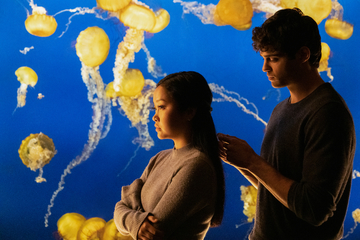


 Marie Lu’s Rebel, the fourth book in the Legend world that takes place in the future in which Daniel’s brother, Eden, is attending university in Antarctica where they’ve settled while June is still working in the Republic. The story, like Lu’s others, have two narrators that are differentiated by the text color as they pace the book out with the developing conflict as it switches fluidly back and forth. The world she creates is superb and the futuristic action is heart-pounding.
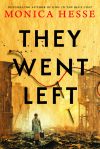 Monica Hesse’s yet-to-be-released They Went Left that’s anticipated for an April release. Not only have I read Hesse’s other YA historical fiction titles, but her adult nonfiction book American Fire. All showcase her skillful writing. This one fits in a newer focus of YA books on the liberation of Jews after World War II like the Morris finalist from last year, What The Night Sings by Vesper Stemper. Hesse dives into this world with Zofia, who has lost most of her family but still holds out hope that her younger brother Abek has survived. Shifting to several places before settling into a relocation camp where she meets a brooding boy, Josef, she is reunited with Abek but questions about what both boys have been through since the war broke out provide the riveting content of the book’s second half. Put this at the top of your list for April.


 Here were some of my favorites to discuss:

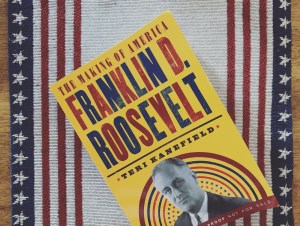 What works well for the series is the chronological organization of biographical information that is equal parts intrigue and straight facts. There’s a humanity in Kanefield’s delivery that does not dilute the truth, yet weaves a story of a person hellbent on creating an America that they had envisioned as they rose to notoriety.fame. With a mix of photographs and eye-catching covers, they’re as star-spangled as the flag.






 Readers Be Advised