This post originally appeared in the Times Union Books Blog
It was evident from the moment our chartered bus from Albany to Rochester dropped us off on the Nazareth College campus that the Rochester Teen Book Festival is in it for the kids. There are signs around the venue’s various classrooms, opening ceremony in the gym, and in informational booklets that priority is given to teens– this means that if there are one hundred seats in a gym, you bet your butt that all one hundred will be given to teens first. Adults are last to be admitted and last to find a seat. And that is how it should be at a teen book festival- the adults (many of which are fellow middle grade and YA book lovers themselves) play second fiddle. I wouldn’t have wanted it any other way because seeing the excited faces of the forty-three teens we brought on the cross-state adventure were all that should be needed.
A Saturday event dedicated to readers.
Bring in twenty authors where you have rolled out the red carpet is exactly what should get your blood pumping. As students scattered with their buddies across the campus to see their rock star authors in the flesh, I found myself listening to a graphic novelist who amazed us with some live illustrating, then a professor leading us in a workshop about graphic lettering, followed by the last two sessions with male YA authors that could captivate anyone with their oratory skills in addition to their amazing literary talent. Plus, I managed to squeeze in a visit to the food truck Macarollin’ for some lobster mac and cheese. Phew!
So when we got back on the bus after my colleague, Kristen Majkut, counted, recounted, and triple-counted as the captain and all-around Wonder Woman of this trip, I settled in with a smile as we learned one of our students won a raffle drawing, another was given the sketches from her visit with the graphic novelist, and the students lovingly petted their new purchases… books. And you think reading is dead? These events serve as constant reminders about the nature of reading for teens. Plus, we have others to remind us too, since we were joined on the bus by YA author Eric Devine. Hours were spent talking about writing, other books, readers, and the target audience: teens.
So, if you’ve never been, mark it on your calendars for May 19, 2018. If you’re a librarian or teacher, bring your teens. If you’re a parent, bring your teen and their friends. If you’re in neither category, donate to the event which each of the twelve years it has been running is a runaway hit with its intended audience. Teens.


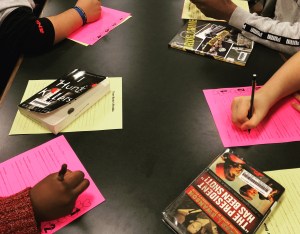 group of fiction, nonfiction that included the graphic novel format and had a forensic theme. They would spend five minutes at each table and circulate until they found a book they wanted to check out.
 But, I was thinking about the art of the booktalk after spending two days in classrooms talking to tenth graders about choosing a classic book to read for their fourth quarter project. I had a lot of ground to cover and not all of the books I had read. Yet that is nothing new because I booktalk frequently on topics that I may only know slightly and I am a firm believer that you can booktalk a book you haven’t read. I organized the books into categories that helped channel the number that I was talking about and then prepared my cheat sheet (things like publication date, title characters, main ideas, themes or topics, or a relevant current topic that paired nicely). And while this is necessary, I generally don’t
  The first thing I did after finishing Goodbye Days at 5am was plot how to connect with Jeffrey Zentner so that we can arrange a school visit for next year. Yes, Goodbye Days was that good. And after staying up past my bedtime months ago to read The Serpent King, it was apparent that Zentner is a skilled author that focuses his creativity on character-driven novels that speak to readers on a deeper level. This is the case with his newest, Goodbye Days where Carver feels like he has blood on his hands after texting his friends as they drove in a car, knowing that they’d likely text back while driving said car, and were killed when they crashed with a half-written text in the queue of the phone. In an instant, Carver lost his three best friends, the Sauce Crew.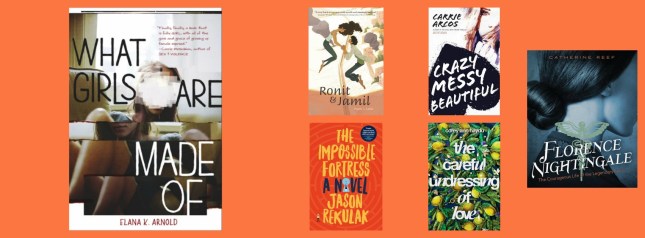
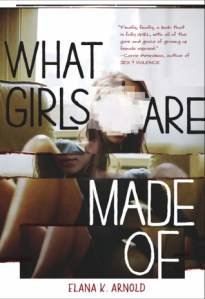 I am kind of obsessed with Elana K. Arnold. I first read Infandous and was enamored with the creativity and depth of the characters. More importantly, though was how the story was told. I had a few readers at the time for it who loved it as much as I did and that added to its appeal. Then, I downloaded What Girls Are Made Of from Netgalley and realized that Arnold is a masterful storyteller. Both books are similar in delivery with essentially two stories woven together and focused on a notable relationship between a mother and daughter with a varied cast of secondary characters and situations to make them distinct.
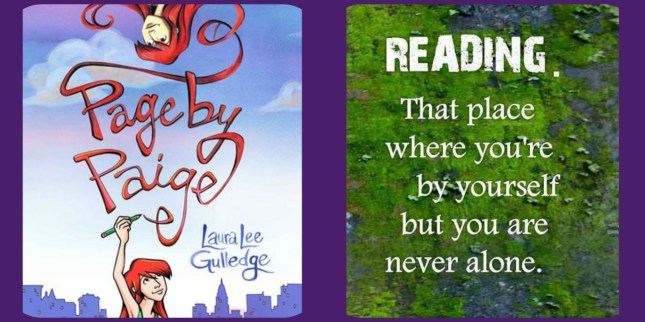
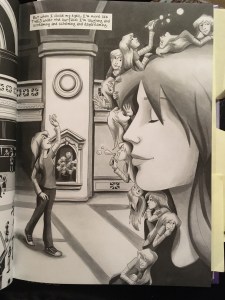 Memorable character: Unequivocally Paige. She is the star of the show and the title character and it wouldn’t be the book about her battle with herself, being in her head, being her every single moment of every single day. Her emotions pour out on the page through the skilled hand of Gulledge to create pages like the ones included through this post. She’s someone who is growing and maturing and reflecting, even when it’s difficult. See all of her huddled around her head? (Don’t mind all of the post-it’s sticking out of the side. We’ll get to some of the others in a moment…
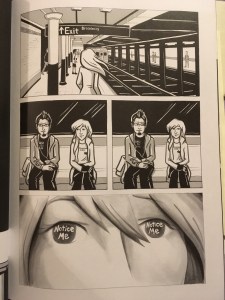 “notice me” in her eyes when she happened upon her love interest. Everyone who has begun to fall in love has felt this way, yes? The perfect marriage of creativity and empathy for Paige.
 Gulledge succinctly interweaves this fear when she’s holding her heart in her hands hoping not to step on the hundreds of banana peels that litter the floor.